After working on it, on and off, since 2019, my daughter, Alison, and I finally finished our Harry Potter quilt this year. To celebrate, we put it on display in the Larson Gallery Guild Members' Exhibiton which opened last weekend.
 |
| with our quilt at the opening reception for the members' exhibition |
The Members' Exhibition is an annual exhibition of work made by members of the Larson Gallery Guild (or, in other words, people who support the gallery). This means the work tends to run the gamut between professional, amateur, and experimental. I remember one year when a local painter showed a wheelchair entirely covered in googly eyes. I don't know that I'd enter this quilt in a juried show, as it isn't my normal "work" but this is a perfect opportunity to show off this collaborative piece that has been in progress for so long.
 |
| postcard for this year's membership exhibition |
The Membership show runs June 14 through July 12, at Larson Gallery on the west side campus of Yakima Valley College. The gallery is open Tuesday - Friday 10-5 and Saturdays 12-5. Admission is always free, and this year's show seemed particularly strong to me, with a wide range of media and work that looked much more professional in quality than some years.
 |
| Alison explans an idea to me during our first planning/sketching session in March 2019 |
Alison and I first started sketching our plans for this quilt back in March 2019 (I had to go back and look at the dates of the photos to check). Alison was in elementary school, had been doing 4H sewing for several years, and was finishing up her third quilt (the first one was doll sized), when we started discussing what we wanted to do next.

After the doll quilt, which was made of squares, Alison created two quilts using designs by Elizabeth Hartman. The first one was a small Fancy Forest quilt. For the next one, she used the fox design from the Fancy Forest pattern to make a larger fox quilt (adding glasses onto three of the foxes). Because she was a kid, I also attended the 4H sewing sessions and helped with the quilts, as well as her other projects. We both learned a lot through doing the Fancy Forest and fox quilts. These quilts both used pieceing, where rectangles and squares of fabric are sewn with straight lines or diagonals to create different shapes. Then the fabric is folded overwith the cut edges hidden behind.
 |
| Alison's Fancy Forest quilt in progress |
We wanted to make our own design for the next quilt, based on Harry Pottery imagery and using the piecing and folding techniques we learned in the Hartman designs. The first pieces or imagery we made for the Harry Potter quilt were the broomsticks (we made two for the quilt and a third as a gift for a friend). The broomstick bristles were based on the top of the hedgehog or thistle from the Fancy Forest quilt, with some modification for where they attached to the handle.
 |
| a Ravenclaw broomstick pillow for a friend |
Fluffy, the three headed dog from book one was based on Hartman's fox head, again with a modified bottom. We had just finished making 42 fox heads, so these three heads came together fairly easily. We didn't use any of her designs directly, but modified several into the shapes we wanted.
 |
| Fluffy, Hagrid's three-headed dog, in progress |
As we started sketching the quilt design, we discussed what imagery would lend itself to techniques we already knew or could borrow from our experience with the Hartman quilts. Hedwig obviously could be done like the owl, the glasses (Harry's and Luna's Specrespecs) could be based on the owl's eyes. The lion's head (from Luna's hat) and the niffler were more distant, but still based on some of what we learned in the Fancy Forest quilt. For others, we just made them up as we went along. Someone recommended that we used paper piecing, but it was the pandmic and we didn't have anyone to teach us, so we just kept doing it our way.
 |
| The nitch, niffler, and Hedwig, in progress |
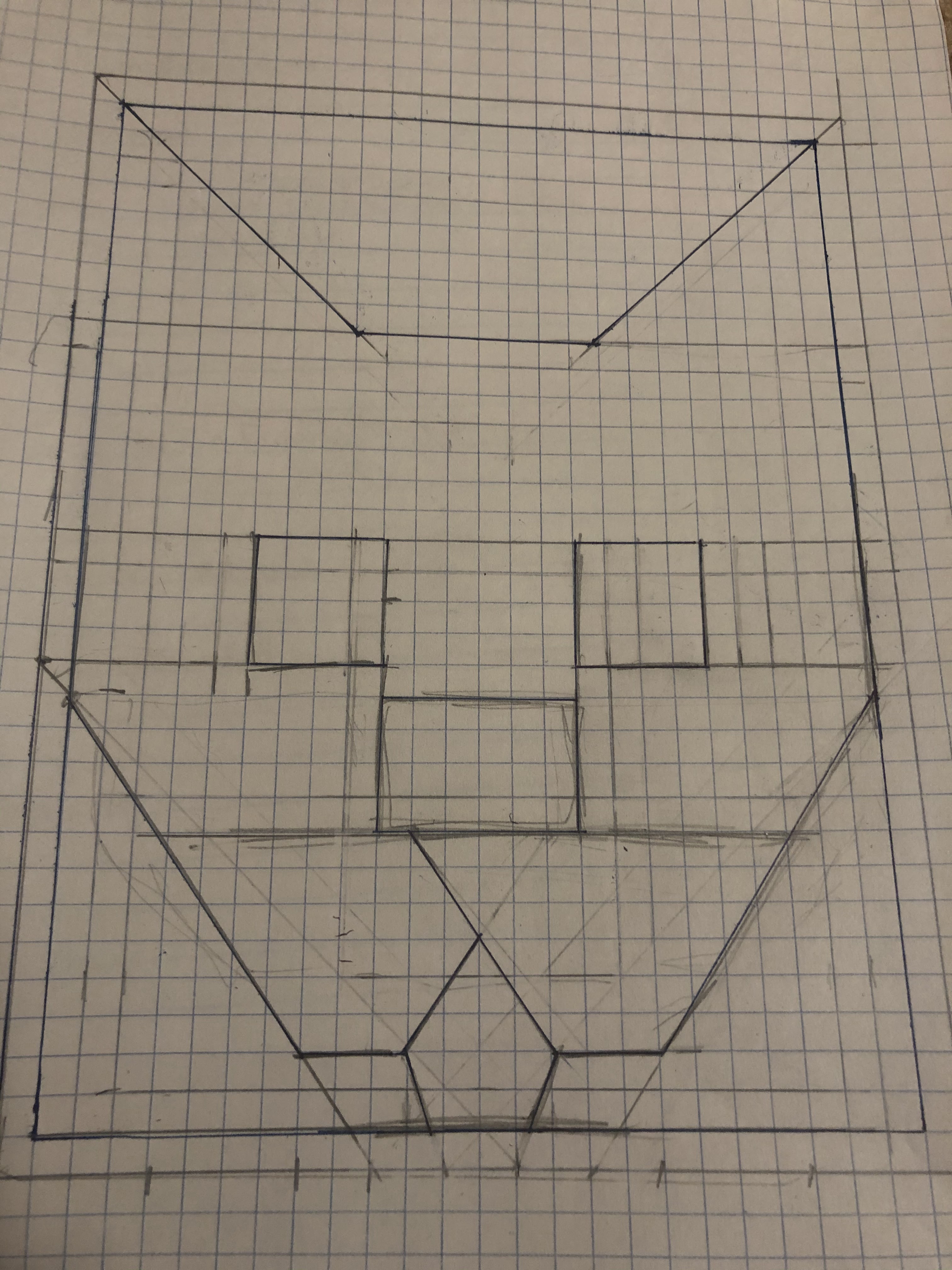
After the original sketch, in which the imagery was decidedly not to scale, we sketched most of our designs to scale on graph paper. This helped us plan for size of elements and seam allowances. I think we skipped this on some of the last pieces we made, like the castle and the snake, but if we did skip it, it was probably because we forgot about the earlier process and because the straight seams and large sizes didn't require it quite so much.
 |
one of the 3 heads of Fluffy, with plans for how to design the tongue
|
As we started actually making each of the designs, they grew and changed as we stumbled, learned, and adapated to what we were able to do. We also learned what we didn't realized we needed to know when we went to put everything together. The adapatations we made as we went along meant that things changed in size, and sometimes color, in ways that required us to move farther and farther away from the original design. Now looking at the finished quilt, I notice where the spacing between elements varies (unlike in our sketch) or Hartman's quilt designs.
 |
| Our original sketch, which we photocopied and colored in during planning |
Looking back at the original sketch, I can see that we stuck pretty close to the original plan in a lot of ways. Our original plan had about 41 separate elements (I'm counting three elements in the bookshelf, and all the Skiving Snackboxes as one element) and 41 in the finished quilt. Our original layout had the snake (Nagini) spanning the entire bottom of the quilt, with Trevor the toad underneath the snake's head and the diadem above. In both quilts, the sword is positioned so that it is about to cut the snake's head off.
 |
| the bookshelf with books, a penseive, and Crookshanks, the cat |
Periodically, after finishing a batch of pieces, we laid out the elements on the floor, both to celebrate our progress and to reconsider orientation, color, and spacing. Color spacing, I think, was what led to the chocolate frog and Trevor the toad switched places in the final design. We also had to start thinking about how to sew different sections together (without trying to sew around corners).
 |
| I'm not sure if this was an organizational plan or jsut what we'd made so far |
When we started the quilt in 2019, we wanted a challenging quilt that would allow us to come up with our own designs. I loved Harry Potter before Alison was around. I read the first three books while living in Japan. Because we had a limited number of books in English, there was a lot of sharing of books. For the last 2 or 3 books I attended book release parties at bookstores, one I remember reading in the car after midnight as I accompanied my husband as he drove around Wisconsin to deliver lost luggage from the airport. When Alison was old enough, I read the first ones to her, and we read the later ones to each other. Reading the books together and talking about the stories translated well to designing the quilt together.
 |
| Alison would often sew while I pinned or prepared the next set of pieces |
Unfortunately, at some point, I started to feel funny about sharing our progress on the quilt (and my general love of Harry Potter), because at some point after we started working on it, the author decided to reject the themes of her books and start using her platform and fame to say hateful things online.
 |
| Scabbers and the grid plan for his creation |
For the Members' Exhibition, we've titled the quilt "We started this before she was a TERF." I was actually surprised during the reception that people mostly didn't know what we were talking about. TERF stands for "trans exclusive radical feminist" or, specifically, someone who considers themselves a feminist but doesn't like trans people. (By "doesn't like" I guess I mean that this person doesn't think that trans people should or do exist and thus have rights including access to bathrooms and/or healthcare.)
 |
testing options for thread color around the appliqued puking pastilles
|
I believe the author started her descent into the anti-trans world by voicing opposition to trans use of womens' bathrooms, but since then she's doubled and tripled down on saying mean things about trans people, extending that to saying mean things about people who support trans people and, more recently, using her buckets of (mostly Harry Potter) money to fund anti-trans legislation in the UK. Also recently she decided to say mean things about asexual people, which seems to simply be an expansion of the unnecssary hate. Why?
 |
| documenting the completion of the deathly hallows |
So, now we're in a world where I feel compelled to distance myself from the author and her views if I publicly enjoy something she created. I don't want to provide the author with any more money--though we've already spent money and time on this project we love. Our financial investment in HP licenced fabric was all done by the time she outed herself as a TERF, but I still feel funny about how connected this quilt is with an author I no longer respect.
 |
| planning sketch for Riddle's diary |
It's the first time I've thought very seriously about "death of the author" (by which I mean, both that the author doesn't get to determine what their work means AND that the author is separate from the work). This is the first author whose work I really loved, who went on to make what I consider a real negative difference in the world. I loved Good Omens; Terry Pratchett has always been one of my favorite authors, while the living author of those books was not. I feel ok about continuing to support Good Omens, since the problematic living author is no longer associated with the TV version.
 |
| tracking which elements we'd created, which ones we had patterns for and...others |
I honestly thought, back in 2020, that the Harry Potter author would get some push back to her original comments, hear what people who disagreed with her had to say, then eventually walk back her comments. I thought at least she would say she respected their perspective, but couldn't fully agree. Instead, she leaned in to saying and supporting things that I disagree with. Thus, my love of the books (and audibooks--Jim Dale is amazing), and this quilt have to occupy an awkward space where I no longer support or respect the author, but still love what we've made and the time we spent making it.
 |
| Crookshanks, basically completed, including wonky edges |
When we started this quilt, I don't know that we had considered how long the process would take. We obviously didn't anticipate the pandemic, which paused our 4H sewing sessions and initially slowed us down (and limited the assistance we could get in problem solving some of the more difficult designs), but at some point the limitations of COVID gave us more at-home time to work on the quilt.
 |
| this one was tough, notice the word "platform" in green |
The next big delay was my stupid cancer, which limited my energy. Then Alison started high school, which meant cross country and marching band and TSA--and we just had no idea how all-consuming marching band would be. Speaking of all-consuming, I took on the union presidency in 2019, then dove head-first into bargaining the contract and pandemic changes, then return from COVID, then 3 years of bargaining the second contract and all the drama that came along with that (things are MUCH better now). For most of that time, the union was a second job, and I was also teaching full-time (or slightly more than full-time).
 |
| at some point we started highlighting the sections we had finished, so we knew which imagery still neded to be made |
Throughout all of this, we never entirely abandoned the quilt, though we'd go months and months without touching it. Some of the hardest times to work on it coincided with some of the hardest decisions to make. At some point we needed to determine how to put it all together. In the original design, we saw the quilt as basically four separate sections that could be put together in pieces, but as the measurements of individual elements changed, that impacted whether the pieces would fit together in a grid, and whether that grid would fit with the other pieces.
 |
| the cat on the bottom right wasn't part of the original design |
The layout always called for having the snake at the bottom, but we never entirely planned for how the snake would fit across that space with it's head somehow above the edge of the elements next to it. We basically just saved it for last. After ignoring it for months, I believe we got the quilt pieces out in late fall of 2024 (after marching band, cross country, and CBA bargaining had all come to an end). At this point, I think we were just hoping to finish before Alison graduated high school.
 |
| Rita Skeeter (as a bug) |
Regardless of how you feel about the author, I hope that you enjoy looking at our quilt. If you are a quilter, be gentle with us, as this is the first design we've ever planned an executed and we did it during a fairly tumultous half decade. If you are in Yakima, check it out at Larson Gallery. If you are coming to Alison's graduation next year, maybe you can see it in person then (since we did, in fact, finish it before she finished high school).
 |
| we had to spread it out on the floor to see the whole thing |
Can you identify all the various elements in the quilt without help?
Here's my key: right to left, top to bottom:
Rows top to bottom
- Weasley's Wizarding Wheezes box (all the skiving snackboxes are falling out across the quilt), scroll, cat plate from Umbridge's office, Fluffy the 3-headed dog, broomstick, Rita Skeeter as a bug
- Sorting hat, puking pastille, dragon egg (tri-wizard tournament), Scabbers, wand with red sparks (hard to see in photo), top of bookshelf, Luna's Spectrespecs, time turner (our design, not based on the movie--because circles are difficult)
- Lion from Luna's hat, Hedwig, Ravenclaw's diadem, Trevor, penseive on bookshelf, Crookshanks, Slytherin's locket, quill
- Hogwarts, Skiving Snackbox, snitch, dealthly hallows, platform 9 and 3/4 sign, niffler, Triwizard cup
- Griffindor's sword, Skiving Snackboxes, moon (Lupin), Riddle's diary with a baselisk fang, Harry Potter's glasses/scar, Marauder's map, broomstick
- Dobby's sock (falling out of the diary), mandrake (hard to see in photo), howler, Sorcerer's/ Philosopher's Stone, quidditch goals
- Chocolate frog, Nagini (getting her head chopped off), divination teacup ("one of the blue patterned ones")