Tuesday, February 1, 2022

Medium Luck

CW: Cancer words, with ceramics pictures


Lucky

Throughout the cancer "journey" I've been bouncing back and forth between whether I'm suffering from terrible luck (my cancer and my nephew's) or whether I've been really lucky given the circumstances.

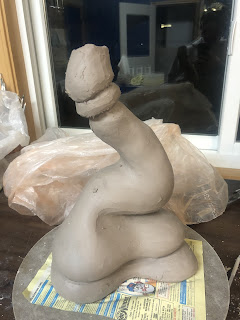
I was able to spend some time in the studio before the last infusion and I finished this piece (mine is the one on the left; the one on the right is naughty).

I keep thinking of this children's book I read with my daughter when she was young. It was called Zen Shorts and the stories were allegories. The one I'm thinking of followed a person whose apparent luck kept switching. What looked unlucky at first turned out to have a positive impact, then a result of that lucky turn causes something bad to happen. It went back and forth, alternating between "good" luck and "bad" luck.  Probably the moral was about perspective or that luck isn't really a thing.

why take a ceramics photo if you can take a cat ceramics photo?

My last few months have felt pretty similar, actually. Obviously one of the first reactions to my diagnosis was that I was terribly unlucky. While I was waiting on the results of my biopsy, I read that 4/5 of all breast biopsies turn out to be benign. How unlucky that I was in the smaller group. A number of the factors of my initial diagnosis seemed like terribly bad luck. The cancer was identified as grade 9/9 (We're looking for a low score here. Cancer grade is like golf, not a spelling test), and it had already spread to the lymph node. How unlucky that my doctor hadn't scheduled me for a mammogram at 40. (Or is it lucky I caught it myself?)

the texture inside took a long time

As soon as I started having conversations with friends who have or had had breast cancer or other cancers, I realized how much research and innovation has happened around breast cancer in the last 20 years and how lucky I am to have breast cancer now because of how much treatment has improved. 

once more with cat

I stop myself here, because this is a ridiculous thing to consider. When I think to myself "how lucky that I have breast cancer instead of some less well-studied cancer," it only takes a moment before I realize that this assumes that I was going to get some cancer and the only variables were what type. Or I think "How lucky that I have breast cancer now instead of in 1980 or 2000" like my breast cancer was inevitable, only the timing up for debate. That's not how anything works, yet that's apparently how minds work.

I'm lucky the cancer was caught early. Or was it late? My primary care doctor didn't recommend a mammogram at 40, because some guidelines say 40 and others say 45 or 50. It's unlucky that she didn't take my concerns in July seriously. But maybe it's lucky that I asked again (and saw someone else) in September.  It's unlucky that the clinic didn't get back to me very quick on scheduling a mammogram, but it's lucky I followed up when I hadn't heard for 2 weeks. The process from first concern to referral to mammogram to biopsoy took a long time, or maybe it was pretty quick.  My cancer grade and stage (I don't officially have a stage because apparently they don't "stage" it until after surgery) are worse than they could be (some breast cancers are caught before spreading) but better than they could be, too. I'm somewhere in the middle on this one, so I guess I have medium luck. No one ever talks about being medium lucky.

I've mentioned several times that I am incredibly lucky (and I stand by this and will keep saying so) to have such a strong support network of friends and family and colleagues to support me during this time. This one isn't up for debate. The people in my life are just great people and I appreciate them so much.

so many cards from people wishing me well

Digression: I am really touched by how people have reached out to me via mail, letters, texts, Facebook, and this blog to just say they're thinking about me. Before my cancer stuff, I didn't realize how much that stuff mattered. Those of you wondering if you're doing enough or if it matters when you say you're thinking about someone whose going through some stuff, my informed response is that it really does. You don't have to be articulate, it just really feels good to know that someone is thinking of you. And I really hope that even when I'm not feeling up to responding, that people realize that I still appreciate them reaching out.

a really gorgeous card, the crane is embossed, not drawn

People reached out right away to offer to feed us through Meal Train. Like, LOTS of people. We are really lucky that people just wanted to do this (and that so many people are so much better at cooking than I am). On the other hand, every other week lately, I've got a few days where I think how unlucky it is that I can't seem to manage to eat what folks provide. This week I got to revisit some of the food I did manage to eat. That felt pretty unlucky at the time. But how lucky I have a husband who can help me deal with the...results so I can just moan and sit on the floor. And how lucky am I that the symptoms haven't kept me bedridden or in the bathroom throughout the entire process. How lucky I am to be able to suffer the symptoms at home and not need to go to the ER or doctor over them.

How lucky I am that modern drugs are very effective against nausea from chemo. (Though might I just mention how unlucky it feels when don't always work.) How lucky that I'm able to eat enough most of the time, and how unlucky that I can't eat dairy, and also peanuts smell offensive (yet they're ok to eat for some reason), and grapes now taste like rot, and some days lemon and lime popsicles are the only think I can tolerate. But also, how lucky that my friend Mary brought me both lemon and lime popsicles a while back.


for some reason, this is one I can tolerate when I can't tolerate much

The biggest bad luck add-on (meaning after the first bad luck of having cancer) is my nephew having cancer. I feel a bit funny claiming his cancer as "my" bad luck. Obviously my nephew his parents and brother own this bad luck much more that I do. But why should our family have the bad luck of having a poor little 2.5 year old have cancer? And why should we have to have two people with cancer? That's super crappy sucky stupid bad luck. On the other hand, how lucky that both of our cancers look pretty treatable. How lucky that only one of us has to do chemo. How unlucky that my newphew's symptoms started out so severe (he lost his ability to walk and lost a lot of control of his muscles and even speech). Except, how lucky that his severe symptoms led to a quick diagnosis and start to treatment.

How unlucky that both of us have months of being immune compromised, and during a pandemic, too. Except, how lucky that we're doing this during the part of the pandemic where I and our families can be vaccinated. How lucky that we're doing this during a time when it's socially acceptable to wear masks in public and our friends are sure to keep their masks on around us to protect us.

Also this gift was particularly good, even though I can't always eat these

How unlucky that we have to spend so much time in hospitals and deal with all these bills. How intensely lucky are we both to be on good insurance so that our families aren't going to become bankrupt because of this. (BTW, how stupid that our country doesn't just have universal healthcare because no one should have to feel lucky to be able to afford life saving treatment in a wealthy country!)

I am incredibly lucky to be able to take time off from work because I have sick leave saved up AND I live in a state with Paid Family Medical Leave. My Yakima oncologist said that many people work through this type of chemo (the SCCA oncologist in Seattle said I shouldn't consider working), because they don't have any other option. I cannot imagine working during the last three weeks.  Unluckily my newphew's state doesn't PMFL, but luckily his parents have semi-flexible work schedules and some work leave. They are also able to take advantage of our folks having good health and a situation that allows them to get to their house to help out. How unlucky that my brother and I live on opposite coasts with my folks in the middle, but how lucky that they are able to travel. And how lucky that we were all able to get together this summer before all-cancer-hell broke loose.

a family boat-train (being chased by an ogre) at the beach this summer

The ping ping match here between good and bad luck hasn't gotten me anywhere (and I knew it wouldn't), but I wanted to write about it because it feels like such a constant refrain in my life. I feel ping-ponged back and forth between these feelings. Consciously, I can easily get some perspective and see the mix of good and bad in the situation and feel very good about the good. Obviously it is easier to keep this perspective when I'm feeling well and because I have so much help and don't have to work.


Chemo Update

I finished my 4th and final Adriamycin & Cytoxan infusion last Wednesday and today is the first day I haven't felt nausea. I am still having some GI symptoms, like indigestion and discomfort. It took me over an hour to get through my breakfast which is a thing now, apparently. 

photo at my last infusion (looking at it makes me queasy)

This last round was particularly bad. I was given some new antinasea medicine on the day of my infusion because I had complained about the length of symptoms the time before. I figured the new stuff was pretty serious because they gave me just 4 pills and the pharmacist was pretty clear about telling me not to take it until evening because it will make me very drowsy. 

my mother-in-law sent me this wig that looks absolutely ridiculous on me

I felt pretty sick on the day of the infusion and took my new medicine and went to bed about 6. I was already feeling bad before I left the infusion room, but it was more indigestion than nausea. The nurse recommended Pepcid and suggested that the chemo messes with my whole GI tract. That makes a lot of sense as I've had most symtoms along that line that I can think of, including a bit of trouble swallowing, which seems random.

the other sculpture (nearly finished) from before the last infusion

The next morning, Thursday, I felt groggy but no nausea and I was able to basically function all day, even though I felt a bit ill. I even had a meeting that morning with the genetic counselor about the results of my genetic test. They tested 75 genes, including ones they know are linked to breast cancer, ones that might be linked to breast cancer, and some linked to other cancers. All 75 were negative, which seems pretty great! That night I took less than a full pill because the pharmacist suggested taking a half dose if I was too groggy and I had a meeting scheduled on Friday morning. I took about 3/4 of a pill rather than half because I couldn't break it evenly. 

texture focus

Friday morning I was exceedingly dizzy and sick and had to cancel the meeting. I felt worse throughout the day and ended up going back to bed for most of the day. I wasnt able to eat lunch and had just a tiny bit of dinner which I got to see again that evening. Saturday I was still pretty unwell. I wasn't able to eat breakfast but did have some lunch and a tiny bit of my dinner. Sunday was much better, but I was still uncomfortable. 

this one was a remix of this old broken one from college

The Sunday level nausea can be more or less kept in check with the original nausea medicines; my desk is covered with bottles and pill packets of 3 kinds of antinauseau medicines, as well as Pepcid, Imodium, and Tylenol. I've also got eye drops and moisturizer for my hands and feet because of how dry everything gets, and a large waterbottle beside my bed because my mouth gets so incredibly parched despite the 3 liters I'm drinking every day.

more texture

Anyway, whine whine, this was the last round of the "dreaded red" and on the 9th I have my first round of Taxol. Everything the experts tell me is that the Taxol shouldn't be as hard on my system as the A/C. I'm feeling a little leery as the one nurse who did my blood draw last Tuesday said that the third round of A/C was worse than the fourth and she was obvioulsy way wrong on that one. But besides her, everyone else said the 4th round of A/C is the worst, so I'm hoping that's accurate.


Thursday, January 20, 2022

Week 6, Staying Strong

CW: Cancer, but also some ceramics again!


Last week I completed 3 of the first 4 chemo infusions and this week I'm about done with 3 of the first four periods of yucky symptoms. I go in for my last dose of Adriamycin and Cytoxan next Wednesday. This round was the toughest as far as nausea and appetite loss. Instead of feeling basically ok(ish) on Wednesday evening and Thursday, like the last two times, I felt pretty terrible on Wednesday and had to go to bed early. 


I worked out today. Very low or no weights, and no impact, but I broke a sweat and felt good at the end. This was about the first time that I got warm enough during a workout to take off my long sleeves, too (but not quite ready to let the chilly bald head out).

In previous weeks, the day after chemo I felt ok, then Friday, as the IV anti-nausea medicine wore off, I felt worse. This time around I felt bad right away on Thursday and had to take the other kind of nausea medicine. They prescribed me two types of anti-nausea medicine, one that's in the IV and one that isn't.  I can use the one for breakthrough nausea on Wednesday and Thursday then alternate the two starting on Friday.

I took this picture after one of my last workouts before beginning chemo. It's maybe a bit of a morbid before, in preparation for a weaker, less healthy after, but I honestly wanted to document those changes that happen during the process.

My nausea continued through Tuesday this week, and was accompanied by an aching chest and torso. I choose to interpret the soreness and pain as the cancer getting killed in that area. I'm not sure if that's exactly what's happening, but that's what it feels like and being in pain while believing that the treatment is working feels better than being in pain and believing it's because I've been poisoned.

I didn't read anything about cancer this time around. In fact, my notebook has directions telling me that I'm not allowed to read anything more about cancer. Instead my carefully curated book and media diet has been carefully curated to include mostly things that will make me laugh. Lots of people gave me suggestions in the last few weeks and I've been enjoying Derry Girls when I can't work up the energy to read and Terry Pratchett, Pride and Prejudice, and the Eyre Affair when I can. Ironically most of those books are rereads, but I've found that's where my patience is right now. 


So many books! Thanks to Linda, Julie, Heidi, Nialle, Shannon, Terri and Jane, but I've lost track of who sent the one on the far right (it didn't have the sender's name, but I think this person mentioned it in an email or text or FB message way back at the start of this journey).


My friends have also sent me books. I literally have more than half a shelf now of books sent or brought or gift carded by friends in both Washingtons (state and DC) and Iowa. I've also been gifted a puzzle from Spain (because Brooke knows that's the kind of interruptable activity that I can handle right now) cancer hats from Wisconsin and Washington, and ceramic yip yips from Minnesota (I know they aren't really the Martians from Sesame Street, but that's what these creatures by Jennifer A Murphy remind me of). 


My ceramic yip yips and one of several books sent by the lovely and thoughful Julie and Linda


During my infusion last week I listened to a meditation program for cancer patients, but that is soothing and doesn't count as reading about cancer. The meditation helped calm me down quite a lot actually, as I was pretty anxious and worried about this round and my reaction to it (I knew that the side effects were likely to get worse with each round). The thing I really liked about the mediation, which was aimed at breast cancer patients, was that it mentioned how to react to the stupid things people say. Basically, it said we might not know why people make these suggestions, but we don't need to pay attention.

the meditation I used last week

The night before chemo I had worked myself into a borderline freak out about whether the chemo was working, etc. I ended up chatting with my friend Linda who asked some strategic questions that managed to calm me down quite a bit. She asked me what evidence I had for my worries, and when I went to actually list the evidence it dissolved around me. I also took advantage of talking to the social worker when she came around during my infusion and that helped a bit too, but by then I had some evidence to contradict the worries of the day before.

The next day, when I met with the oncologist, she asked if I felt the lump shrinking and I said no, not really. But she felt both the lump in my breast and the lymph node under my arm and said she felt they were shrinking. My knee-jerk reaction was to think that she was just placating me, but she honestly doesn't seem like someone who is overly optisimistic or would say something just to make me feel better. She's a bit brusque. When I first met her she said something to the effect of, you're smart, you've already talked to the SCCA (Seattle Cancer Care Alliance) people, you don't need me to tell you all of it again. I was a bit taken aback, but her plan matched the SCCA plan and straight-forward and efficient seem like good traits for a doctor.


So many books from The Haunted Bookshop in Iowa City by way of Heidi and Nialle!


Anyway, I posted about what my oncologist said on Facebook and presented it as good news (because it is). Here's where my community again comes in to bouy me up. I suggested that she's probably better than me at gauging the size of a lumpy thing inside a squishy thing. My friends Shannon agreed and argued that gauging the size of a lump in a breast is a bit like learning to throw pots; it takes practice. It's a good and helpful comparison. Of course an oncologist is better at judging lump size. I'm better at throwing pots because I practice a lot, but I also don't have an emotional and fear reaction when I'm throwing a pot. I'm guessing my brusque and intelligent oncologist isn't in pain or terrified when she checks the size of my lump, and she's got a lot more practice than I do.

I also got a second bit of information that day that made me feel better and function better through some of the side effects from this round. When I go in for an infusion, the first thing I get is IV steroids and anti-nausea medicine. Then comes the chemo poisons. One nurse gets my port accessed and starts the steroids/nausea medicine, but two nurses have to check the chemo before it gets hooked up. I'm a big fan, by the way, of this approach. The first time my Adriamycin was labeled incorrectly and they had to send it back to the pharmacy. It makes me feel safer knowing there are three people involved in verifying what I'm getting is correct. 

On the advice of a friend, I bought a silk scarf because they said it felt good. It's true, but the added advantage is that my young neighbor thinks I should have more hair so she can style it. This scarf is long enough to style into a very long ponytail. The only trouble is that she didn't leave much on my head, so the first picture I took didn't really show what she was excited about.


Last Wednesday, as they were checking my information and my drugs, the one nurse started saying that what she was looking at on the computer was "way way good."  I asked what she meant and she said that my immune system numbers were "way way good."  Earlier the oncologist had told me my numbers. My white blood cells were up becaues of the growth factor, I am slightly anemic and something else was a bit low. I didn't understand what she was saying except that I was cleared for more chemo. The nurses phrased it in a way that made me feel a lot better about the situation. I'm guessing my numbers are "way way good" in comparsion to other chemo patients, not, like, the general population, but I'll take it. 


My friend Nina brought me this ultra snuggly warm hat. I think she heard me say that I had to wear two outside. This thing is sooo soft on my bald head. It feels great and keeps me very warm.


I feel that I can interpret "way way good" immune system numbers as a sign that I'm doing well, but more specifically, I can choose to interpret that as meaning that I'm doing what I should be doing. I'm not teaching this quarter, which I think is good, as I'm feeling sick for 5 days in a row, but it also means that I've got more time to myself on the days when I am feeling ok. As I like to keep busy and have some kind of structure to my days, I've been assigning myself the work of eating, drinking, walking, and generally trying to take care of myself (although the baseline for that is different than it used to be). 

I've been keeping a log of symptoms in this Personal Health Tracker for Cancer patients that showed up in our Little Free Library. (I'm convinced someone who knew I was dealing with cancer left it specifically for me. Thanks unknown person!) I've also been tracking other kinds of things I'm doing for my health in my own notebook. My motivation is that I like checklists, but also I figured I might be able to kind of gauge whether things I've been doing are related to symptoms or how I'm feeling. I'm also supposed to drink 3 liters of water each day and as that's a lot, it helps to write it down. So far the main thing I've learned is that on the days when I feel particularly bad, I just don't write anything down. 

the tracker that was left in our little free library

The things I think I'm doing for my heath are drinking enough, eating (maybe not enough, but better than if I didn't have eating as a goal), doing some kind of meditation, yoga, walking or exercise (though this has been surprisingly difficult for someone who is used to walking to and from work and working out pretty before breakfast most days). I also figure that reading for pleasure and trying to do something fun or creative are also helpful.

The exercise has been the biggest surprise for me. I remember when I was newly pregnant and was very frustrated that I couldn't keep up with others on a walk or a hike. I honestly didn't feel that being not hugely pregnant should make me get winded so fast.  I feel similarly on the chemo. I'm 3 infusions in to a 16 infusion cycle (or 6 weeks into a 20 week ordeal) and I already am finding it challenging to go for a short walk around Davis. A half hour yoga session requires me to take breaks and I'm basically never getting 10,000 steps, though before the chemo my daily goal was 12,000 and I often got much more. Obviously the freezing fog and unpleasantly chilly weather (and ice, and snow) is impacting my walking, but I'm still frustrated aboutmy lack of walking endurance. 

my symptoms tracker in the Write Track book

The main identifiable symptom is nausea, but that seems to manifest as both nausea and indigestion (even when I haven't eaten much). I'm still exploring the possibility that small amounts of dairy are at fault for some of the indigestion.  The ice cream last time around knocked me out for two days of severe indigestion. Since then I've been avoiding all milk and ice cream, but I'd still been using a bit of butter and small amounts of cheddar cheese until yesterday when I realized that the previous days' symptoms (indigestion, sore back) were pretty similar to the ice cream symptoms. I decided not to have any more cheese, and though I felt better yesterday, I was also on schedule to feel better, so it's hard to know just yet what's the cause. Also a lot of food I usually eat has dairy in it!

I am also waking up with headaches. I take medication for migraines, which used to interrupt my life regularly. I've been pretty good with them for a number of years because I know my triggers (stress, too much or too little caffeine, lack of sleep, etc) and avoid them. Waking up with a headache isn't all that unusual for me in times of stress, but I feel frustrated because I don't think I'm that stressed except for the, y'know, general having-cancer stress. And maybe a bit of my-nephew-has-cancer stress and I suppose when I can't get through my breakfast I don't finish my tea (not enough caffeine) and when I don't feel good my sleep is a bit interrupted.

I also have soreness all over for days after the chemo. This time I know it lasted through Saturday, but Sunday and Monday were the days when my discomfort or my mood prevented me from writing anything down until after the fact. I also have bone pain. This comes from the growth factor. The first round it started exactly a week after the chemo. This time I felt like it started earlier, but before the pain in my back happened both as a symptom of eating ice cream (lactose) and from the growth factor, so it's a little hard to tell whether the growth factor or the cheese got me on Tuesday. The bone pain was pretty strong yesterday and was not accompanied by indigestion, so at least that's a known cause. Somehow it bothers me less knowing that the growth factor is responsible for that pain.

my own water/medicine/activity tracker

I feel like my symptoms are both minor and sucky. I often feel that writing here helps me think through things or see them in a way I haven't before. Kind of like when I was chatting with Linda and she asked me some questions and my answers made me realize I was feeling differently than the evidence warranted. So I've been feeling like I'm being pretty unreasonably whiny about minor symptoms like pain and nausea that are either eliminated or severely reduced when I take medicine for them. And the other symptoms of getting winded, feeling indigestion, and generally feeling low all feel like things that should be within my control. Maybe if I had walked more when I was feeling really bad I would be able to walk more now. I can vaguely recognize that maybe I'm being harder on myself than warranted, but writing out what I'm feeling in words (not just a chart) helps me gauge the size of the issue. I've got four paragraphs of symptoms. Maybe that's not nothing. Maybe I should be a little gentler on myself.

Ok, but it wasn't all moaning and feeling awful this week. I also managed to find a narrow lever of motivation, wedge it up onto a tiny little fulcrum of energy, and slide myself into my studio this week. I wasn't sure I was up for throwing (wedging, lifting, cleaning, pushing, all in a studio not connected to central heat, and then needing to trim the next day seemed like too much commitment). 

plates waiting to be fired

Instead I inched my way into the studio with little tasks. The first day I cleaned bats. I'd thrown some plates back in October or November when I thought I could make Christmas gifts this year, but I'd never gotten around to cleaning up. The next day I prepped some too dry clay for the pugmill. A few days later, I pugged some clay and used just a bit of it to start a couple of small sculptures. Turning on the space heater earlier in the day and knowing my clay is waiting has gotten me into the studio most days this week. And making with clay just makes me feel better. It's not exactly exercise, but it does feel like medicine. It feels like being me. I didn't set myself much as a goal other than spending some time on these. I figure at this scale with two pieces, I have time to finish the building and work on the surfaces before I go in for my next chemo. I'm guessing I won't want to work on them after that. 

an awkward vase (in progress) based on a sketch from years ago

Getting into the studio provides a mental and physical change of pace to my day and gives me something pleasant to do. It also gives me time to listen to an audiobook without getting distracted and takes my mind away from thinking about cancer or chemo. Of course it helps that the orange cat likes to come in and jump up on the table when I'm working. 

A kind-of cactus I wanted to try again after the first one broke


I was scaring myself again this week, so a change of activity was useful. My friend started chemo with the type I will be having for the last 12 weeks. Her dose is higher than mine will be, but she had a really tough week and that's been scaring me a bit. I was hoping that my next dose will be the worst of the whole 16 as that's what one of the nurses suggested. My next one is the last of the Adriamycin and Cytoxan together. After that it is 12 weeks of Taxol. 

When she was giving me my growth factor shot, the nurse said that I wouldn't need those shots during Taxol because it will be less hard on my immune system. Actually, she said something along the lines of "woah, you're on the tough one now." She also indicated that the nausea won't be as bad on the Taxol. 

I started to work on the final glaze layer for this guy, but there's something wrong with how the second layer of underglaze stuck, so I'm not sure I want to mess with it. Clay is more fun than underglaze.


But my friend's experience was scaring me, so I called my other friend whose done Adriamycin/Cytoxan and Taxol before. She calls the Adriamycin the "dreaded red" and indicated it was pretty rough for her. She actually had to check whether she'd done Taxol and then indicated it wasn't as bad as the A/C. That matches what the nurse and doctor said, but it's nice to have confirmation from someone whose been there.  

It was a balm to talk to her, and not just because she had good news about Taxol. There's something about talking with someone who has had the same experience or who is having the same experience that can be helpful, but especially so if they have insight about how they think about the whole process. Her advice was to try to focus on one day at a time and not try to think too far ahead. I like to be in control, have a long-term plan, and know what's coming up, which cancer and chemo don't really allow for. Sometimes talking with someone who has also struggled with the changes that cancer and chemo forces can feel both validating and refreshing.

I talked to my brother this afternoon, too, and we agreed that maybe it's not important to have the "right mindset" but the right mindset for you. Some of the overly cheerful or everything happens for a reason stuff makes me want to punch, but I appreciate that it works for others. The way I like to think about the pain in my chest as evidence of the battle going on inside might not work for everyone, but it works for me. Realizing I've been doing this for 6 weeks already (wow) makes me feel like I've accomplished something and thinking about my strong body and "way way good" immune system (so far) make me feel like I do have some control (and I don't need to hear if that's likely to change or whatever).

Monday, January 10, 2022

Hair Loss and Lactose Intolerance and Emotions

 CW: more cancer stuff, also Lucas, also sadness


The last time I was in to Northstar for my growth factor injection, I asked if I would have to get a shot after every infusion (I hate shots, so I was hoping I might not have to have 16 of them). After the first 4 infusions (the first 8 weeks), I will be switching to a different type of chemo. She indicated that I will not be getting growth factor shots during those last 12 weeks of chemo because that type won't render me as immune compromised (the first 4 infusions are two types together, the last 12 weeks are just one). Not only that, but the nausea isn't expected to be as bad during those weekly infusions. The good news is I should feel better and be less at risk for other infections and not have to get shots. The bad news is, well, weekly infusions for 12 weeks, but we already know that.

I was smiling because I found a bandana that wasn't too hot, but also nearly halfway through the bad stuff!

What that means to me is that tomorrow basically marks the halfway point for the "bad" chemo. The bad chemo is the every other week infusion of Adriamycin and Cytoxan with the growth factor shot the next day. I'm happy to celebrate a halfway point, as the aftermath of the last infusion was kinda rough. On the day of the infusion or maybe the day after, my hair started falling out in clumps and the nausea seemed to last longer than the first time around. I was feeling okay on Thursday, the day after my infusion, but for the next few days I was nauseated more or less constantly (they say the antinausea medicine from the IV wears of on Friday). I also found the thought of food to be disgusting for a longer period than last time.

My husband hanging out with me for the second infusion


Emotions

Unfortunately, this was also an emotionally difficult time. My nephew, who is not yet 3 started suffering some scary symptoms around Christmas and was finally diagnosed with his own cancer. Early suggestions were that it is operable and won't require him to go through the kind of garbage I'm doing now, but his family is meeting with the cancer team tomorrow, so we're still in the yucky unknown time. Obviously the whole family is having a difficult time and we'd like to publicly ask cancer to take a f-ing hike and leave us all alone. My brother and his wife are meeting with their own cancer care team tomorrow, so all my fingers and toes are crossed for them. Prayers gladly accepted if that's your thing.

Like I said, it's been a hard two weeks and I wasn't sure I wanted to chronicle this crappy time, but I do sometimes feel better letting it out than keeping it in. Words on the page sometimes lose their power to hurt or the hopeful/positive ones gain some solidity and comfort, at least for me. I'm also considering the possibility that I might want to reflect on this week later in the process, though I'm not sure that will be true.

Hair Loss

I was surprised by the things that knocked me for a loop this week and surprised by my reaction, really.  When my hair started falling out, I yelled in surprise, even though it happened exactly when and exactly as I was told it would. The type of chemo I'm on causes total or near total hair loss in 7-21 days after starting, according to my Breast Cancer Treatment Handbook and other text sources. My doctors have all been clear that I'd lose my hair, though they didn't specify exactly when. I was in the shower exactly 2 weeks after starting chemo when I ran my hands through my hair and they came away absolutely covered in hair. Losing my hair in the shower in this way is exactly how a fellow breast cancer patient described it during my first infusion. I shouldn't have been surprised, but somehow pulling great clumps of my own hair out wasn't something that I was able to prepare for.

lol, I've got gaps in my hair

That day I was in a bit of a hurry to shower before going to an appointment, so I finished my shower as quick as I could, cleaned up the hair out of the drain, and headed out. I took a few photos of my hair loss, both in the drain and on my head. I'm not sure you could tell from the front, but the sides and back seems pretty wild to me. At this point, though I was surprised, I also found it funny to observe the changes. (I was not feeling nausea on this day).

lol, that's a lot of hair (at least for someone with a pixie cut)

The next day, expecting the same thing, I left myself more time to shower. And the hair just kept coming out in clumps in my hands. In fact, I became sort of fascinated and couldn't figure out how to stop. I'd run my hands gently through my hair and they'd come out covered in hair. I'd wash the hair off my hands and my shoulders and repeat the process. I finally realized that I'd been in the shower for quite a long time and there was going to be no logical end to the process of hair coming out, so I had to just get the hair off me and stop.

a bald patch in the back, as predicted by Nialle

At this point, when I looked in the mirror, I felt I looked like a halloween decoration. My hair was exceedingly thin, but not gone, which just looked odd. The color was wrong because what was mostly visible was head. I looked sickly, I thought. I was already feeling nauseated from the chemo anyway, and looking at my hair or thinking about my hair loss made me feel worse. This was really not what I had expected as my reaction to the hair loss. The day before, when I wasn't feeling sick, I thought it was kind of funny and mostly interesting. Seeing it while I wasn't feeling so good, or seeing it farther along made me feel worse. I did not take a picture on this day and tried not to take off my hat.

Over the course of the day and the next morning, I discovered that the hair I still had was also really uncomfortable. I'm not sure if it hurt or if it was just sensitive. The feeling all over the top of my head was like when you've had your hair in a tight ponytail all day and then taken it down; the hair feels like it wants to fall in the wrong direction. I was also feeling sick all day and worried about my nephew and worried about myself. I didn't want to look at myself and I didn't want to think about more hair coming out in the shower.

I eventually asked my family to shave my head. I figured this way I'd be taking charge of something (since everything else seemed out of my control). I felt like I could deal with no hair better than some if it were my decision. It would cut my shower time down significantly (because I wouldn't have to pull it out and then work to get it off my hands and shoulders), and I wouldn't have to keep washing my hats and clothes because they were covered in the hair that fell out during the rest of the day and night.


the inside of my hat on the second day


The shaving was odd, as my head or my hair was so sensitive. It didn't hurt, but it did feel kind of icky (also, I felt icky anyway). It also took forever for some reason, probably because my daughter was trying not to hurt me. After she was done I still couldn't look at myself for another day. In a couple days I was comfortable enough to take a picture, now I'm comfortable enough to walk around without a hat until I get cold. I bought several "chemo caps" in preparation for the hair loss. I'm glad I did because I was able to wear them to catch the extra hair, but also because they are more comfortable for sleeping in than a winter hat.

Now that I've been bald(ish) for over a week, I find that I need to alternate between the cotton or bamboo caps, winter hats, thin cotton bandanas, and nothing because my head keeps changing temperature. My working hypothesis is that hair is a better temperature regulating feature than fabric of any kind. Hopefully I'll get mine back eventually. 

you can tell by my face that I wasn't quite ready for this look

I also discovered that walking outside with a winter hat on isn't sufficient. I didn't really think about the fact that my warmest winter hat is lined around the ears and the bottom edge, but the top is unlined crochet with holes. When I wore it outside for a moment, I really felt the chill up top. Stocking caps also aren't quite sufficient for outside, but they can be good when I'm feeling really cold inside. My new normal is to wear one of the specially bought chemo caps or a scarf under my regular winter hat when I go for a walk.

Lactose Intolerance

My other discovery of this round came when I was finally starting to get over the nausea. Our neighbor brought us a few slices of apple pie right when I was starting to feel like I could eat again. I've never been a huge fan of fruit pie, but this one looked amazing (and was). I heated up my slice, added a small scoop of ice cream, and enjoyed. It was really, really great. 

I only added a small scoop of ice cream because I was already beginning to suspect that too much dairy wouldn't agree with me. After the first round of chemo, I'd tried a milkshake, which likewise tasted great but later made me feel sick. Thinking that yogurt might be better, a few days later I tried a smoothie with similar results. But cheese had been fine, so I figured it was worth a shot with a small amount of ice cream.

Apparently one can develop lactose intolerance during chemo (hopefully temporary). Milk, ice cream or frozen yogurt, and soft cheeses have more lactose than hard cheeses. The internet says that yogurt is ok, but I'm too scared to check. My stomach hurt for 2 days after the ice cream. When my daughter made mozarella sticks last night, I opted for one where all the cheese had fallen out (disappointing). I also bought some lactose free milk for my tea and discovered that lactose must be an important element of flavor. I've been just drinking my tea black since then. 

The Chemo/Nausea/Sneezing/Energy Cycle

As you can probably tell by the fact that I've scraped myself up off the couch and am writing, I'm feeling a lot better. This weekend, I think, I started getting back to myself. The pattern I'm starting to see is that the day of and maybe the day after chemo I'm fine. Then I feel mild, but constant nausea for 2-4 days. This week it was longer, but some of that had to be the ice cream. This week I also had indigestion through the second week. On Saturday my energy level increased (it was earlier the round before) and I started sneezing and having a constantly runny nose, which is much improved today. The first time around the sneezing started a bit later and stopped on my infusion day. Today I've been feeling good, except that my bones ache periodically (the growth factor).

Tomorrow I will be going in for my blood work, followed by the infusion on Wednesday. I'm hoping that I might be able to talk to my doctor about the nausea and the indigestion, but surely at least 2 days of unpleasantness will be helped by avoiding dairy. I've updated my information on Meal Train so that those lovely people bringing us food can also help me avoid lactose and focus on what I've been able to eat (soup, salad, and bread, mostly).

More Emotions

I'm not sure what to do to avoid the emotional pits and drops this time around. The hair surprised me, as did my nephew's situation, of course. I might also ban myself from reading about cancer for a while. I read two books (well, I read the relevant sections of two books) on cancer this weekend. The first, about breast cancer, made me feel a bit better, especially how she talked about diet and complementary therapies. I also learned that staging doesn't usually happen until after surgery, and I learned a bit more about neoadjuvant (before the surgery) chemo, but the stuff I read about breast cancer spread and recurrence did not make me feel better.

Overall I'd recommend this book, The New Generation Breast Cancer Book by Elisa Port, MD

Then I read a book about cancer more generally. This book, The Cancer Companion, was not focused on breast cancer and had what felt like a lot of emphasis on incurable cancers, recurrence, and palliative care. It made me wonder more than I'd like to about my long-term prognosis. The book talked about how important it is to be clear with your doctor and ask for information on prognosis, but I think the problem has been that they can't guarantee me that I'll be fine. 

Maybe I shouldn't be reading this now

This weekend my daughter got her COVID booster shot and the next morning was feeling very bad and even threw up. I called the ask-a-nurse number and spoke with someone about her symptoms, asking whether I should be concerned. I was pretty sure that these symptoms were within the realm of reasonable responses to the booster, but I wanted to be sure I wasn't underreacting (since our family, lately, has had symptoms turn into real problems). I also wanted to clarify whether I should be tending her because of my immune compromised state. She's fine now and my take away from the conversation was that I was correct in my impulses: she was having a reaction within the realm of normal, including symptoms she'd displayed before. The nausea was maybe amped up by her fear (gee, that doesn't sound like me, at all--sarcasm marker) and she was fine. I was also fine because she wasn't sick, her body was gearing up to be prepared in case she got exposed later, but it was fighting a vaccine not a live infection.

All of this was probable and not alarming, but the ask-a-nurse woman kept asking if she'd suffered a head injury or been in the hospital in the last month. And the nurse wouldn't say to me that I was definately ok taking care of her because she could have coincidentally gotten sick at roughly the same time as she got the vaccine. All logic and timing pointed to this being a reaction to the vaccine, but the nurse couldn't guarantee that was the case.

That kind of thinking, at least in part, plays a role in my doctor's responses so far, I believe. They can't guarantee that I will survive because, not only are we dealing with a probability issue where my chances of not having cancer later aren't 100%, but also I could have an unexpected allergic reaction, or get exposed to something nasty while on chemo, or get hit by a bus, or fall into a sink hole, or suffer some other freak accident that was or wasn't related to my cancer and treatment. 

Evidence that I'm feeling better: I baked today


My understanding of my prognosis is that the doctors are pretty confident that they can remove the tumor and lymph node(s) during surgery. The chemo beforehand may make the tumor smaller and shrink or eliminate some of the lymph node involvement (=less to remove), but I think it's main goal is to "mop up" any tiny bits of cancer that might be somewhere else in my body to prevent spread. From my weekend reading, the neoadjuvant chemo also helps the doctors determine my chances of recurrence after the surgery because they can see how my cancer has reacted to the chemo. I hope this means that they can determine how to help me if my prognosis is bad, though I obviously prefer that they can just tell me my prognosis is good.

the kolachky were opening up so I rolled some of them like croissants


In the happy daytime, I understand the reasoning and the goals and feel confident in my treatment plan. I think that agressive neoadjuvant chemo is a good idea and my doctors are doing what they should be doing. In the happy daytime, when my tummy doesn't hurt, I know that if I can't feel my tumor shrinking it might be because it's early in the chemo process, and/or because it's hard for me to feel if it is shrinking, and/or because the cancer could shrink while leaving funny feeling non-cancer stuff behind, and/or because the goal here isn't necessarily to shrink the tumor, but to "mop up."  

But, oh, in the impatient scary nighttime, there is a lot going on that is just outside my control and makes me worry. It's hard to fight back against unknowns and fears and I'd feel a lot better if the doctors would just say "you will definitely be cancer free by September and you'll also live to 100 along with all your friends and loved ones."  Why won't they just say that?

In the meantime, I'm thinking it's time to return the cancer books, or at least set them aside for a while. I've got this long list of funny books and I think I'll be better off focusing there. On a side note, my daughter is like me on needles and was dreading her booster shot, so when we got to Rite Aid, we started watching "Who's on First." By the time they gave her the shot, she'd forgotten why we were there. Now that's a ringing endorsement of humor and escapism. 


Tuesday, December 28, 2021

Why did I get Cancer?

CW: Cancer (still not ceramics). Nothing queasy-making this time, but some performative 


Why did I get Cancer?

Since my cancer diagnosis, I've been trying to figure out why I got cancer. I think the question is natural, both from the standpoint of how to prevent this in future (or how I could have prevented it or how my daughter and friends and family could avoid it in future) and from the "why me?" kind of emotional reaction to the bad news.

Immediately I found that the world (the internet, books, podcasts, doctors, friends, random people) has two or three kinds of responses:  

Stuff Happens

The response from the medical professionals with whom I have communicated (for the record, that's at least 11 individuals with whom I've talked about causes) has been uniformly "we don't know" and there isn't a clear cause for this. 


Why me?


The serious books about breast cancer have also pretty consistently supported the argument that there's basically no reason why I got cancer. I find this frustrating, which is why I've kept searching, but I have to admit that right now there isn't a good answer to the question of why I, specifically, got breast cancer. To be clear, there are some clear risk factors, including lifestyle factors, but they don't appear to be relevant to my situation.

According to The National Cancer Institute, as of November 14, 2021, my risk for developing breast cancer between 2021-2026 was .7% 

It's a Gift

There's another camp that goes in for the "everying happens for a reason" and "this is an opportunity to grow" crap that belongs in Hallmark cards that belong in the trash. This is the idea that breast cancer can be a wake-up call to me to change my life or love my family more or create the life I'm supposed to be living...or build an effigy of this soggy sentimentality, tie it up in pink ribbons, and burn it to ashes before anyone else in this position has to breathe in its toxic positivity. This stuff doesn't cause me any anxiety. It is stupid. No one I care about has tried to sell it to me, and all I feel compelled to do is point it out in an effort to ensure that nothing with a pink bow comes near my life right now. 


We already owned these scissors. We bought them years ago because they were cheap. My family thinks its funny to offer them to me when cutting needs to happen, but I prefer the orange Fiskars in my desk.

Toxic Sludge

The third type of response, when looking for why this happened is, in my opinion, a pile of toxic sludge. This is people, books, websites, etc with the answer. Usually the answer is simple (sugar! stress! deodorant! bras! meat!) and implies that the person who got cancer could have (easily) avoided their plight had they just been more virtuous, those lazy slackers.

I think these kinds of "easy" simple answer come to us as a result of an incomplete understanding of science combined with the search for easy to market answers. These ideas come mostly from hacks and quacks selling books and promoting diets, videos, and/or podcasts. These victim-blamey sound-bite answers are harmful to people in general and especially women with cancer. (Men also can get breast cancer, but the toxic sludge is clearly aimed at women.)  

Honestly, I see a lot of similarities between these ideas about breast cancer causes and the kinds of body shaming, blame-the-mother, and anti-women rhetoric and ideas in our society. I also see a similaritiy between these ideas about breast cancer causes and the low-logic, high-fear rhetoric of Qanon type consipracy thinking (the cancer doctors are out to get us because they're evil and want us to buy deodorant with aluminum in it and wear too-tight bras!). 


What Actualy Causes Cancer

So, obvious caveat here: I am not a medical professional. I write this blog because it helps me process my thoughts and feelings (usually about ceramics and teaching). Lately I've been writing to process my fears, anxieties, and, today, rage about my own personal breast cancer diagnosis. There are lots of good resources and I'm only trying to process what these resources (and others) have said. Read them for, like, facts and stuff. Read me because you care about me or because you like my color commentary.


Breast Cancer Treatment Handbook by Judy C Kneece, 9th edition, 2020 (the book the folks at Ohana gave me on Nov 15)


I started with the Breast Cancer Treatment Handbook that I was given when I was first told I have cancer. This is the only one I've pretty much read cover to cover (I didn't read about all of the different types of chemo medications because by then I knew which ones I'd be getting). This book was very helpful, especially right away, in just getting me some basic information. It's a pretty quick read. They've included comments from other breast cancer "survivors" about their journey, and though the quotes are in pink calligraphy, and a few of them are #2 above (i.e. my diagnosis changed my life, what a gift), most of them are useful or relatable.

Dr. Susan Love's Breast Book, 6th edition, 2015

Dr. Susan Love's Breast Book is thick and I certainly haven't read it cover to cover, but I'm working my way through the sections on causes and prevention, chemotherapy, and complementary treatments. The early section on the biology of what causes breast cancer is useful, in my opinion, for getting a laywoman's understanding of the mutation process that causes cancer. I had read similar information already, but the repetition is useful, as are Love's analogies. The author compares DNA to a cooking recipe and the immune system to neighborhood watch, local police, and national guard. 

Part of the reason I like the focus on the biological process of how cancer develops is that it isn't simply a on-off switch and the causes are complex and interrelated. It's not like silicosis, which is a type of cancer caused from inhaling silica dust. This is a type of cancer that clay folks know to be concerned about. If we don't keep our studios clean and don't wear masks when mixing clay and glazes from powder, we can inhale tiny silica particles in the clay which irritate our lungs and can eventually irritate them enough to cause the disease. Pretty straightforward, in this situation, to see the risk, see how it leads to the problem, and, in this case, avoid the risk in our daily lives.

Breast cancer hasn't been clearly linked to one single cause like this. Though being a person with breasts certainly makes is much more likely that you will develop breast cancer, a lot of people with breasts don't develop breast cancer. Also, it's significantly harder to avoid having breast tissue than it is to avoid breathing in silica dust. 

So, there are a few factors that have been shown, with reliable scientific research, to impact your chances of getting breast cancer. Being a woman makes it more likely (men can get breast cancer because men have a bit of breast tissue). Not having a child, not breastfeeding, or having a child later in life can make it more likely. The density of one's breasts can also make breast cancer more likely. 

There are also some genetic risks, though genetically linked breast cancers are pretty rare. Only 5-10% of breast cancers (or is it people with breast cancer? I'm not sure if that 5-10% counts people or individual instances of cancer, as one person could have cancer multiple times and someone with a genetic predisposition might have it more than once) have a genetic cause. 

As I am young for cancer (and presumably because I don't have other clear risk factors), I have met with a genetic counselor and will be doing a genetic test. According to the list of 9 items that would make my doctors recommend a genetic test, I meet the criteria 2 or maybe 3 times. Number one on the list is simply "Personal history of breast cancer, diagnosed at or before forty-five" (page 98, Love).

There are also some lifestyle things that can impact one's risk. These are the ones that make me mad. Dr. Love's book doesn't specifically make me mad, but I keep looking for a reason or something I can change to lower my risk going forward and I keep butting up against these top few suggestions. I find these when I'm looking for lifestyle changes I can make under the category of "complementary therapies." First, I should try not to be overweight. Done. Second, I should try to work out. Sigh. I do this already. 

I should not drink to excess (I probably have a total of less than three drinks a year). I should not smoke (I don't always see this one listed for breast cancer, but still, it isn't relevant to me). Then the list of suggestions becomes a little more vague as we move on from these. Maybe diet might impact breast cancer, but we're not sure how. Fruits and vegetables are good for you, maybe eat more?

This is the point at which I invariably throw up my hands (or throw down the book I'm reading). Depending on my mood, I'm now mad because I already do all this. I don't drink, don't smoke, I've got a healthy BMI (there are some real problems with BMI as stand-in for health, that I don't need to bring in here, but if you're curious, I've been really enjoying the podcast Maintenance Phase, in which the funny hosts research various health and wellness topics, including BMI and talk about their research). I work out regularly and walk to work regularly. I eat pretty healthy most of the time. According to the damn list, I shouldn't have breast cancer.

A handy list on page 147 of Love, of things I already did. (I even tried to do #9, "Have a doctor evaluate any breast symptoms or changes that develop" in July, but by then it was already too late.)


If I'm in a more melancholy mood, I realize that I could work out more than I do. I only "do a workout" maybe 30-50 minutes at a time 3-5 days a week. I could be doing a lot more. One time I took a week off. And I only walk to school most days. Maybe I should be running. Maybe I should move farther away from work so it'll be a longer walk, or run. And my diet isn't 100% healthy. I sometimes eat candy or ice cream or fast food. Do I always eat 5 servings of fruits and vegetables each day? Probably not! What if they aren't the right fruits and vegetables anyway? And what about that mojito I had in 2019?

I believe I am mentally stable enough, most days, to break myself out of the thought spiral above. My husband helps by reminding me that compared to a lot of people I exercise quite a bit and eat pretty healthy. But having cycled through both sets of thoughts on this list of risk factors and lifestyle changes for a few weeks now, I think I've come to a realisation. And that is that I never did enjoy statistics or probability. 

If I had understood probability, I might have understood how sometimes the thing with the low statistical odds happens anyway. In the real world, there isn't a committee that looks at your diet and exercise log, measures your BMI and assigns breast cancer only to the folks who didn't do everything on the darn list. 

Seriously, probability is stupid and I didn't like it when I was trying to learn it in school and I don't like it now. But I have come to a kind of equilibrium in my feelings about risk and lifestyle factors. I'm becoming calmer about it and I think I can confidently say that I developed breast cancer for no reason. I didn't do something wrong. I didn't deserve it. I didn't screw up and let it happen. It wasn't my fault and, unfortunately, it doesn't appear to be anyone else's fault either.  (Which is what my doctors said in the first place, I just wasn't ready to listen.)

My lifetime risk as of early November, according to The National Cancer Institute.


Why my Rant isn't Over

My path didn't move in a direct line from good advice and good resources to comfort with the idea that this wasn't something I could have controlled. Instead I've bounced back and forth between different resources as I've tried to navigate which ones are reasonable. Along the way, I've encountered some things that have really frustrated me and made me feel bad (bad, guilty, scared, worried, all that).

The good news is that very few of these frustrations have come from actual people. Aside from a few odd interactions, mostly from random people (as in, not friends and family), people I know have stuck to wishing me well and agreeing that cancer sucks. They've also brought me food and listened and offered to listen and brought/sent cards, and well wishes, and gifts, and at least 3 people have offered Alison a place to stay when we're in Seattle, and even offered to help with groceries or Christmas shopping. Friends with cancer or who have gone through this before have offered invaluable advice and suggestions about all manner of things (so far the vast majority of the advice from everyone has been helpful and all of it has been well-intentioned and makes me feel supported).

The annoying stuff has come mostly from books, podcasts, and online resources, most of which I have encountered while I was trying to find out more about either why I got this or what I could do to help it go away (besides following medical advice). To be fair to my medical professionals, the very first day the woman at Ohana told me to stay off of the internet for questions about cancer (I listened to that advice a medium amount).

Food, maybe

When looking for books about breast cancer, its hard to know what is reliable and what isn't. In fact, SCCA gave me a list of books that I think includes some duds. For example, I started reading Dr. Kristi Funk's book, Breasts: The Owner's Manual and it seemed reasonable for a while. It called out some myths about cancer causes, but I stopped reading when I got to the section about how diet impacts breast cancer "a lot." This contradicts what I got from Dr. Love's book (as I understand it, she says that we're not sure what parts of diet matter). Dr. Funk goes on to talk about prostate cancer and diet, tells us that coffee or caffeine doesn't cause cancer but also suggests that it is bad for cancer. Then she tells us dairy isn't a breast cancer cause but that you shouldn't drink it because of saturated fat. Then she goes on to talk backwards and fowards about meat. I have no idea what her point is or if she is recommending avoiding meat.


Funk's writing style is chatty and includues a lot of questions she only kind of answers, but I couldn't follow it. Perhaps the book is ok, but it seems to focus a lot on what to eat or not eat and she hasn't convinced me that she knows. Her diet advice might be ok, but her writing style and the ways in which this advice contradicts what I hear from my doctors and what I've read in the two reliable books doesn't give me upmost confidence in her book or the primacy of diet in controlling cancer. 

I do think that I will keep exploring diet in these books that I haven't finished, and, of course, we can always make our diets better, I'm sure, but the reliable information seems to be conflicting at best and I'm not convinced I need to fret about what I've already eaten or what I can tolerate during chemo. Bottom line, it does not seem clear that my fairly healthy omnivorious diet caused my cancer. During chemo, it seems clear that keeping myself hydrated and eating something is most important. Trying to change my diet isn't recommended right now, and I wouldn't know what to change it to anyway.


The Most Toxic Sludge

While I was looking for resources, I came across some podcasts/podcast episodes that focus on breast cancer. I've listened to a few individual episodes about chemo supplies (Breast Cancer is Boring), Meal Train (Breast Cancer and the Unknown) and Fewer Breast Cancer Cases (The Exam Room). These have so far been mildly helpful and the Breast Cancer is Boring podcast is fun.

I haven't listened to a lot yet, but so far I am enjoying this one.


Then there's this podcast, The Model Health Show by Shawn Stevenson. This podcast made me sooo angry. Honestly, I only got about halfway through it because I kept stopping the podcast to angrily fact-check the host. The episode is The Truth About Breast Cancer and yes, I now realize that the click-bait title should have warned me off, but I was in a fragile state, okay?


In the first 23 minutes of this one single episode, this guy tells us that antiperspirant and bras somehow block the lymphatic system from working, causing aluminum to back up through the lymph system into the breast where it causes tumors. He explains that because women shave, the aluminum in the antiperspirant goes into our system, whereas men who don't shave their armpits don't get breast cancer. He says that cancer is a wake-call for us to live differently and suggests that if your bra leaves a mark on your skin at the end of the day, that should have woke you up, too. He vaguely blames lotions that women use and wants Victoria Secret to change their products so that women won't get cancer. He blames sugar for breast cancer and tells us that biopsies cause metastasis or spread of the cancer. And finally, he explains that "groundbreaking" research tell us that more people die from chemotherapy than from leaving the breast cancer untreated.

This dude is a charlatan and is making the world less safe. Seriously! I want to know how this guy is allowed to spread his garbage without getting called on it?  Because once I started to feel skeptical, I tried to look him up; I tried to find critical reviews. There was almost nothing!

Biopsy Spread

As I said, I did look up a bunch of these claims. There is a small chance of a biopsy spreading cancer, so it's possible, but accoring to this Cancer.net article, it isn't something we should be overly worried about and the idea that we should was spread via a guy who lost his medical license. Without that information, it is still hard to understand how a doctor would confirm that you have cancer without checking and biopsies seem like a pretty standard method for doing that. If you couldn't biopsy, it seems like you'd just have to do major surgery on anything that might be cancer. Before my biopsy, I looked up the numbers and found that 4/5 biopsies do not result in cancer. Before my diagnosis I liked that my odds were 80% for it being ok. Stupid probability.

Antiperspirant and Bras 

I didn't look up the antipersirant and/or bras block your lymph node theory because I had already encountered it. It was also debunked in Dr. Funk's book. Your body has a lot of lymph nodes in a lot of places. They drain stuff in association with your blood flow. I don't totally understand all of it, but you can't just shut off your body's drainage and blood flow by wearing a tight bra. I mean, your bra would have to be astoundingly tight. You would know that something was wrong. I'm thinking you might crack a rib. 

The lymph nodes aren't the same as your sweat glands and even if they were, it seems reasonable to assume they don't collect stuff from the skin under your arm and drain it into your breast. That would be an unsafe and frankly bizarre way for your body to operate. What would happen in you fell in the mud? Would you end up with mud cancers in your breasts? Here's an article from the American Cancer Society debunking some of these myths around deodorant and antiperspirant. This article also talks about aluminum and parabens.

Sugar

Sugar is another of his bugaboos. The story is a little more complicated here, and frankly boring. See this article from Cancer Research UK to read more boring information about sugar and cancer. My summary: cancer cells use sugars, so do other cells. Being overweight or obese is linked to higher rates of cancer and lots of sugar can help you gain weight. Severely restricting sugar from your diet can be harmful during chemo because severely restricting your diet can be harmful. See? It's boring because we already know all of this. Cutting out sugar won't magically cure cancer, but don't eat too much for a variety of reasons. This boring, complicated answer jibes with the unclear information about diet in general. Try to eat healthy, but we're not sure exactly what that means or how much it matters anyway.

Treatment Kills

The last thing this guy talked about was really surprising, which is probably a good metric to use to eliminate advice out of hand. If it is really shocking and contradicts everything you've been told, maybe it isn't true. He said that chemo is one of the most harmful causes of cancer. He goes on to refer to "groundbreaking research out of UC Berkeley, led by Dr. Hardin Jones" into Tamoxifen. He quotes Jones as saying "my studies have proved conclusively that untreated cancer victims actually live up to four times longer than treated individuals," and explains that people who refuse treatment live an average of 12.5 years compared to those who opt for treatment (chemo and surgery) and only live an average of 3 years. I quoted him here because it is so much! 

I tried to look up this "ground breaking" research and this claim. Again, I am not a professional knower of medical research techniques, so I may just be wrong, but I figured this person and the claim shouldn't be too hard to track down. The link from the podcast page sends us to a bizarre article on Rethinking Cancer that appears to be posted but not written in 2020 and the only author name seems to suggest it was written by Jones, when it clearly wasn't. (I'm not including the link because I don't want to encourage connections to junk websites, but is easy enough to find via the podcast name if you want to look.) As far as I can tell, this Dr. Hardin Jones died in 1978. (I found a younger Hardin Jones, but he does not appear to be a doctor or researcher specializing in cancer.) If this is true, its hard to understanding how 43+ year old research is ground-breaking! 

The other relevant website I found was AnonHQ, with an "article" titled Berkeley Doctor Claims People Die from Chemotherapy, Not Cancer (again, I'm not linking to junk, but it's easy to find if you want to). This piece of media is incredible, really. The text below the video says that in the video we hear from Dr. Hardin B. Jones. But the doctor in the video is clearly identified as someone else. But wait, it gets better! Two paragraphs later is an alleged quote from Jones with a hyperlink to his "study."  When you click on the study, you get to a pretty random website--one of those text only pages with an unclear title/date/ownership. On the other hand, this text-only page includes author name and list of references, which is more than I can say about AnonHQ and Rethinking Cancer. The thing about this link, though, is that it contradicts the text at AnonHQ that it has been linked to (seemingly to provide support). This text only article puts Jones in context explaining that this presentation at which he derided ccancer treatment was in 1956. You might not guess it, but a bit has changed in the past 65 years!

Condescending Wake-up Call

On his podcast, this host guy is having a fake sort of dialogue with a female cohost (I didn't find her name after minimal searching). Her job is to act shocked or agree with whatever he says. I think she's meant as a proxy for what his audience is supposed to be thinking, but I kept thinking how condescending the dialogue felt. He's clearly selling something (diet books, podcast, etc), and this is an infomercial, but it just makes me mad that it's sold to people who are already upset and off-balance because of their recent diagnosis. And what he's selling is snake oil. None of this stuff is the cause of the cancer, taking off your bra and eschewing your deodorant isn't going to help, and refusing treatment based on medical advice from the 50s is actually going to hurt people!

This guy says that a cancer diagnosis should be a wake-up call to change one's life. But once we remove the garbage from this list of advice, I'm left with nothing. If I don't buy into his false and dangerous ideas, I'm back to square one. The wake up call is to...um...do exactly what I was doing already, but get more mammograms? I got cancer for no reason and that simply sucks, but it this guy doesn't have a solution for me or a product for me to buy to make it all better.


More Subtle Toxic Sludge 

Besides the crap so efficiently collected on this guy's podcast, there are two more kinds of things that have really irked me in looking for causes or solutions. One is explicitly identified as a cause, the other is more insidiously wrapped into wellness/fitness culture. 

Stress

This one I've encountered a couple of times, but I'm not sure of exactly where. I do know that I encountered this in a support group thing that I've been using. The app is Breast Cancer Healthline and it's bascially a self-contained Facebook for breast cancer folks. The content is mostly semi-organized discussion groups where people with breast cancer can talk to each other about symptoms, treatment, living with cancer, etc. So far it has been mildly useful, if a little depressing, and non-toxic. 

The other day a woman asked a question about whether stress had caused her cancer. The idea that stress causes cancer upsets me, though not at much as most of the stuff identified above. According to Kneece, in my Breast Cancer Treatment Handbook, "The average breast cancer has been in the body for 8-10 years when it is discovered." Other sources give different ranges from 2-5 or 3-9 years. As far as I can tell, the rate of growth varies too much between and within cancers to have really accurate information on this. 

But the issue I see is that breast cancer (maybe especially when the lump is found by the breast owner themselves) isn't likely to have developed just recently. If your original cancer mutation happened because of stress, how long do you go back to find that stress-based cause? If I had a stressful life event 5 years ago and things have been fine lately, does that mean stress is to blame for starting my cancer? What if things were peachy 5 years ago but the last months have been really tough? Does that mean my original mutation was random, but the stress made the cancer grow? Pinpointing the start of the stress that caused the cancer feels a bit like reading a horoscope. I'm sure that all of us can find at least one stressful event within the last 10 years of our lives that we can blame for either the original mutation or the continuing growth of the cancer.

The next part is defining the stress event, which doesn't seem to be clear in what I've read. When we blame stress, are we blaming a stressful life event, like an accident or losing a loved one? Can it be the regular stress of grading during finals week or does it have to be acute, long-term, or unusual? Or are we just talking about how stress is handled? Can two people with the same life event perceive it as stressful or not that stressful? Can you handle your stress with yoga and mediation or does it have to be eliminated entirely? We can't answer these questions because the folks blaming stress don't seem to know what they mean. It also isn't clear to me that studies have been done to check that we're blaming the right thing.

The corollary, and the reason I see stress-as-cancer-cause as an insidious and toxic scapegoat is that blaming stress (especially without a clear definition of what that means) seems a lot like blaming the person with cancer. If you have cancer, this implies, then you didn't manage your stress well sometime in the last decade and thus are responsible for your own cancer. And you know we're all going to fail that test. BreastCancer.org agrees with me that stress doesn't cause breast cancer. 


Wellness

This last one may just be me getting cranky during all this searching for a cause, but a week or two ago a friend who teaches fitness classes posted a meme along the lines of the one below. It said something to the effect of "If you do not make tiem for your wellness,  you will be forced to make time for your illness." 
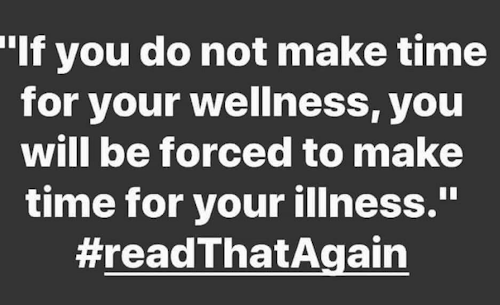
I found this unattributed quote image at Julie Genney Coaching, where, to be fair, she contextualizes it in relationship to healing from an injury.


Can you see why this makes me mad?  I've been making time for my wellness by exercising regularly, eating healthy, doing yoga, lifting weights, walking, running, getting regular checkups, taking my vitamins, etc for most of my adult life. I have made the time and you know what? You know what? I am now making time for my dang illness. And there was nothing I could have done about it.  

I know that this meme is supposed to be motivation to go to the gym or whatever. And if it works for folks, I guess that's fine, but seeing it this month just made me cranky. It implies that folks with illness didn't take the steps to prevent it. I did! It looks like a guarantee that taking these steps before will innoculate me against getting an illness later. It didn't! 

I did not do anything that should have led to me getting breast cancer. And you know what? If you're reading this because you have breast cancer, your probably didn't either. Cancer came and it got us for no clear reason other than that we live in the world and the world has stuff in it that causes mutuations and some of those mutations turn into cancer. 

Picture an idyllic time before deodorant and bras and traffic and McDonald's and soda and cigarettes and chemo and biopsies and office jobs and airplane and cell phones and whatever other damn thing we're blaming for cancer today. Are you picturing that time? Let's go way back, say 4000 years ago, before all that modern crap existed. At this time, the ancient Egyptians had breast cancer. The ancient Greeks had breast cancer. A few hundred years ago people had wacky ideas about what caused breast cancer (kinda like now). Breast cancer is a thing that happens and we don't understand exactly why.

An exellent book on the history of cancer. I read it back in the day and then re-read it this month and enjoyed it more as it meant more this time around.


One more thing about wellness and stress and cancer myths. I've had a lot of people tell me that it is really important to maintain a positive attitude. These people mean well and they usually accompany this advice with an offer of help or with actual help. I'm a pretty baseline-cheerful person, so I mostly take this suggestion to have a positive attitude as it is meant: they care, they aren't sure what to do, and they want to assure me that I'll be ok. (I hope I'll be ok, I mostly think I will be, but as Tig Notaro says, "It might not be ok"). 

I think it may be helpful to maintain a positive attitude so that I'm not grumpy and sad and so that I don't just curl up in a ball on the couch and cry. But as a treatment strategy, the evidence is not there that a negative attitude will make your cancer worse. And cancer sucks, so my take is that if you wanna feel bad for yourself, cry, rage, be upset, etc, go ahead and do it. We don't need to feel guilty on top of feeling sad or depressed, because our reasonable emotions aren't making the cancer worse!


Complementary Therapies I'm Willing to Try

I don't want to suggest that all complementary therapies are worthy of derision (though I do enjoy making fun of those that are). Complementary therapies, as I understand it, are ones that don't stop you from proceeding with the medical treatments recommended by doctor, and that might help, but don't cause harm. They may be known to be beneficial or just suspected of helping. They may also be a better fit for some people than others (for example, my fear of needles makes me reluctant to try acupuncture). 

The main thing, from my perspective is that you don't need to feel guilty or responsible for your cancer if you can't try or maintain these complementary therapies. A healthy diet can be a complementary therapy, but I would argue that restrictive or fad diets would not be because they could harm your ability to stay healthy during chemo. 

The complementary therapy that has caught my eye just recently is laughter therapy. Basically "laughter is the best medicine."  My folks mentioned this the other day and and it is identfied in Dr. Love's book, too. She didn't identify research to support it, but it certainly can't hurt, right?

Your Assignment

So, to everyone who keeps asking what they can do to help, I've got an assignment for you: I need books, streaming movies/tv, and/or podcasts to make me laugh. I'm talking laugh out loud, fall out of the chair would be best, make my stomach hurt from laughing instead of nausea. What makes someone laugh is subjective, so I've been trying to think about what does it for me. I'm thinking satire of modern life, silliness, and not too much blue/body humor. I'm not sure how one finds a humor match, so I figure I'll include some things I already know I like:

Fiction: Terry Pratchett, Douglas Adams, The Thursday Next series. Pride and Prejudice, Harry Potter, (Apparently I'm an anglophile), Christopher Moore, Where did you go Bernadette?. I don't understand why A Confederacy of Dunces or White Teeth show up on lists of funny books (I thought they were both depressing).

Essaists & Comedians: Sarah Vowell, W. Kamau Bell, Sloane Crosley, Lindy West, Phoebe Robinson, Tig Notaro, Mindy Kaling, older David Sedaris (I haven't been as amused lately, idk why)

Podcasts: Wait Wait Don't Tell Me (especially when Paula Poundstone, Hari Kondabolu, or Maeve Higgins are on), Maintenance Phase, The Bugle/The Gargle, Politically Reactive, Don't Ask Tig

Movies/TV: "Girl" Ghostbusters (the one with Kate McKinnon and Leslie Jones, in fact, it would be nearly as good if it was just Kate McKinnon and Leslie Jones on screen for 2 hours), The Princess Bride, Monty Python and the Holy Grail, Dr. Who (specifically Matt Smith's seasons), The Good Place, Crazy Rich Asians (Awkwafina). The vast majority of my TV/Movie watching over the past 5-10 years has been with my daughter who really dislikes romance and swearing, but I figure while she's at school (and I'm not working), I might be able to watch things she wouldn't tolerate.