Jayleigh Butler, Winter 2021. Jayleigh's carved pieces include bowls with different surfaces, a liddled form and a segmented form.
The third project in my Spring class was carving from a solid block of clay. I added this project in Winter. This wasn't a technique I'd ever used before in my on-campus classes, but I thought it might be a good fit for online students working on their own at home. It also fit well with the tools we had in our studio kits.
Ryann-Elizabeth Fridley, Spring 2021. These deceptively simple forms are hollow underneath, like a bowl placed on its rim.
The carving from solid technique wasn't one I'd done before, exactly, though the concept is much like what students do for their solid portraits in the on-campus version of this class. The on-campus solid building has more steps and the process is longer and more complicated, as they are building on an armature. Students are able to build larger and more complicated forms on campus and they have more in-person guidance from me, which is really vital.
Ryann-Elizabeth Fridley, Spring 2021. In the on-campus portraits, we hollow out the sculptural forms so they will survive the firing (and be lighter in weight).
Kristin Benjamin, Winter 2021. This set of 3 boxes is very similar to the liddled forms in the Zak Spates article.
The concept is pretty simple, really. Students start with a block of clay and carve out the inside to create a bowl. They can modify the shape of the block of clay before they carve out the insides, or they can segment it and carve out multiple interior parts.
Sophia McDougal, Winter 2021. Sophia's segemented form started as one oblong lump of clay.
The on-campus solid portrait project requires them to do more shaping before they carve out the insides, using an armature to support complex or top-heavy forms, but once the exterior shape is formed, the carving is similar for more and less complicated forms.
Ashley Lawson (Instagram link), Spring 2021. Ashley's bowls exhibit a range fluted textures that vary with the length and orientation of the cut.
For the online class, I had students start with bowls. Each student was required to carve 3 bowls from solid blocks of clay. They could shape these starter blocks by wedging, slamming, paddling, or carving them. The interiors could be started by pressing in as demonstrated in the Elena Renker article, but the rest of the carving would be done with loop tools that come in students' studio kits.
Student Example, Spring 2021. The cups on the sides show faceting marks, while the center form is fluted.
I didn't have size or shape requirements for the bowls, just a requirement that the thickness of the walls be consistent all the way around and through the bowl. Students could choose to make their bowls wider, taller, more round or more square. I also encouraged students to vary the surfaces of their carved bowls with faceting or fluting techniques.
Lizbeth Cardenas, Spring 2021. Another segmented carved form with deep cuts in the surface. These sorts of deep carvings could be highlighted with glaze after firing.
From the virtual distance of the instructor (not sharing a physical studio classroom together), it appeared that most students generally enjoyed or felt comfortable with the bowl carving. I did have one student who was really afraid to get started.
Student Work, Spring 2021. This very large segmented piece is still fairly wet. You can tell that the student either carved it fairly wet or added some water to the surface. For a big wide form like this, the approach is fine, but working too wet (or too dry) can make things harder and is sometimes hard to judge when working independently.
The fear of the first cut is something I've experienced a lot in the carving part of the on-campus solid building portrait project. Students have spent so much time getting the shape right, it is scary to cut into the project. I have found that my presence is really important for this step. I used to have the students watch my demo in class, then cut on their own.
Mia Bautista, Spring 2021. This mushroom house was probably made from two separately carved forms put together. Something similar could be made from carving from one solid lump of clay, but the more complicated form requires more complicated carving or hollowing techniques.
Since 2018, I've flipped my on-campus classes, having students watch video demos outside of class, then they come to class ready to cut; they don't have to cut until I'm there. I love this day, because I get to simply tell most students that they are on the right track, their plan is right, yes, they should cut. Then I stand there as they start, giving encouragement and watching them be successful.
Jackeline Corona, Spring 2021. I encouraged students to measure the thickness of their walls as they carved. The student has clearly cut away clay at the corners of this segmented form so that those corners aren't thicker than the rest of the walls.
For obvious reasons (classes were entirely online), I was unable to provide this in-person support to students in the online class. Most were, apparently, fine with cutting, since they hadn't spent much time shaping before they began to carve out the shape, but at least one really struggled with getting started on her own. I zoomed chatted with her as she got out her materials and got started, but it was frustrating for both of us, I think, to try to replicate this in-person assurance via video instead of being together in a shared space.
Sophia McDougall, Winter 2021. The uneven facets down the walls of this lidded form create a kind of key to line up the lid correctly.
I do think that teaching our studio classes online has allowed us to reach students who didn't have access to studios before. Confident students, students with acceptable work spaces, students without full-time jobs and loads of family responsiblites, and students who feel comfortable working almost entirely independently can be very successful in online classes.
Kristin Benjamin, Winter 2021. Kristin clearly was able to use the written article and accompanying pictures from Ceramic Arts Network to help her plan and create this interesting lidded form, but not all students feel comfortable working this independently.
On the other hand, many students benefit from a teacher helping them build their confidence. Many students need a dedicated work space and a dedicated work time, both for their own organization and working, but also as a buffer against jobs and family responsibilities that otherwise encroach on the space and the time at home. Online is great and it meets a need, but it's hard to watch students be less that fully successful when I know that being on campus at least a bit would help.
Harrah Hanson, Spring 2021. The figural sculpture (sculpture of a head) requires more planning than a bowl, as the narrow neck has to be a little drier to support the wider, heavier head.
This carving project, like all the online projects, was spread over 2 weeks. In the first week I asked students to carve bowls, in the second, I asked them to carve something more complicated, including segmented forms, closed forms with lids, and closed sculptural forms. Students were allowed to choose which of these they wanted to pursue.
Student Example, Winter 2021. This set of lidded forms have similar shapes, especially in their lids and handles, but varied surface treatments.
In winter, I hadn't initially given them the choice of a closed sculptural form, as that is more complicated to building and to cut and carve. However, in meeting with one student, he expressed interest in building a small portrait sculpture so I talked to him about the risks (big heavy head on a narrow neck) and let him give it a try.
Student Example, Spring 2021. I get a kick out of this photo. The student has addressed the problem of how to show the best angles of everything, by propping stuff up on the slip container and a sponge.
Students were required to create a total of 6 carved objects, including the bowls and the more complicated forms. They were also encoruaged to create a variety of textures on the surfaces using mostly carving, faceting, and fluting techniques done with the same loop and carving tools they used for the shaping.
Lizbeth Cardenas, Spring 2021. This set includes two complications: lids and segmented forms, as well as different shapes for the "bowls" and a variety of surface decoration techniques.
The project came in the middle of the quarter in Spring. I thought of it as a bit of an easier project in between slab-building and coil-building. This project allowed students to do less planning, in most cases, than the slab project, and was a faster technique than coils. It also gave them a chance to try some reductive surface decoration techniques, since most of them preferred impressions, rolled textures, or additive techniques in their slab project.
Mia Bautista, Spring 2021. This form looks like a sculpture from the front, but a segmented form from the back.
Ashley Lawson, cranes (pre-installation), online hand-building Spring 2021, this installation is not featured in the DoVA show, but will be featured here on this blog in future.
This year we were hoping to have an on-campus show, since Larson Gallery was open at some point for other shows, but at the time we were to install the students' work, the gallery had to have its floors replaced. Larson is in a new building and the floors were somehow damaged or installed incorrectly. The gallery is now open in person for the membership show.
Patrick Byers, Breakfast in Bed, on-campus functional pottery, Winter 2020
Because we couldn't be in person, we decided to move the show online. Putting together an all-virtual show was still a bit of a scramble, and it was made more difficult by the fact that with the status unknown for so long, and the classes all virtual since last Spring, I hadn't collected student work or images of student work since Winter, at least not in an organized fashion. In fact, the make-up of the show consists mainly of work collected in Spring or Fall 2019 and a bit of work from Winter 2020, though much of the accompanying paperwork for the DoVA show wasn't completed due to the abrupt end to the quarter, and thus nothing was showing from my on-campus hand-building class.
Patrick Byers, Tritone, on campu functional pottery, Winter 2020
I ended up photographing work that was left in storage on campus for the DoVA show, but only ~2/3 of the students who had left work in storage responded giving me permission to show their work in a different format (and time) than they'd originally agreed to. Some students had moved away, others maybe weren't checking email or just didn't have the motivation to respond to yet another thing this year. Significantly less than half of the students who had initially agreed to show work on campus in Spring 2020 (which would be students from Spring and Fall 2019) responded to my requests to send in pictures or bring in work for the virtual show.Winter 2020 students mostly didn't get the chance to fill out the paperwork which is usually done during finals week (the finals week that was abruptly moved online).
Lacey Velazquez, Cosmic Twister, on-campus, Intro to Clay Fall 2019
Very few students from the online classes (Fall 2019 and Winter/Spring 2020) agreed to show their work this year. I'm sure the low turnout for online classes was a combination of timing, the extra work of taking quality photos of their work, and me not being there in person to pressure them to participate. They'd already made work during a particularly challenging time. On top of that, we were asking them to take photos, fill out a document with a bunch of info they might not 100% understand (like sale price/NFS, dimensions, etc), adjust their file name and size, and email all that back to the gallery and their instructor. That's a lot of hassle, especially if you aren't totally comfortable with manipulating files and maybe also lack confidence in your work. This was exhausting for me, I can't imagine how it felt to students.
Kimberly Owen-Long, Mountain View, on-campus, Spring 2019
It really is too bad, because I had some really neat work this year. I taught three online Design and three online Hand-building classes this year, but only one student example from each shows up in the DoVA show. I did ask permission to show their work on my blog, so for those who gave permission, I plan to do so in future posts.
Harrah Hanson, stacking set, online Spring 2021, this work is not featured in the DoVA exhibition, but will be featured here on this blog in future.
I hope that when people look at the Larson Gallery show and even my blog here, they realize that what ends up in the show is only a fraction of what was made. I prefer to have explicit permission from students before sharing work on this blog and I didn't always get it, but I do have more permission to show work here than work submitted for the Student Exhibition online at Larson.
Kaitlyn McPheeters, Viking Woman, on-campus Intro to Clay Fall 2019
Making the work this year, was expecially challgening, especially for the clay students, but not only for the clay students. Besides navigating an entirely online world for demonstrations, support, techniques, critiques, and grading, they also had to learn photography, uploading, and file management for a class that isn't designed to deal extensively with any of that. They didn't have in-person help for any of this and they had to make do with whatever tools or space they had at home.
Clara Hamill, Untitled (pit fired), on campus Intermediate wheel, Spring 2019
"The show represents a small sampling of the commendable results of remote learning at YVC over the past year. It is a testament to the tireless efforst of educators and the drive of students during a time of stress and uncertainty. Students have had to not only navigate the unfamiliarity and challenges of online education, but also adjust their lives and living spaces to accomodate impromptu art studios. Faculty members, working with limited resourcces, have had to devise new mthods of instruction to remotely communicate the tactile concepts that are best desmonstrated and experienced in person. Despite the many unavoidable setbacks of this period, the Department of Visual Arts is proud to be able to showcase some of the excellent work that continues to be produced by the students at Yakima Valley College."
You can see some of that student work at the Larson Gallery website for the duration of the Student Exhibibition (through July 2, 201). Be sure to click through to each image, as the Instagram style square boxes of the main page impose artificial size and shape restrictions on the work, an especially unfortunate situation for vertical ceramic forms and horizontal compositions or groupings. There is also a video at the bottom of the DoVA page from my online clay stop-motion-animation project.
Ashley Lawson, pinch set, online Spring 2021(follow her on Istagram) This work is not on display in the DoVA show, but will be featured here on this blog in future.
I have featured some of the work from the DoVA show (with the appropriate propotions) above, as well as some work from the most recent quarter in my online clay class that didn't make it into the show (not because of merit, but because of the complications mentioned above). I plan to create some more posts in future on this blog that feature and discuss student work from both the online clay and online design classes this past year. Stay tuned.
Detail from the graphic syllabus or course map, showing the carving from solid project. I like the little carved bits that surround both weeks.
This week is spring break. It feels good to take a bit of a real break, though today I spent the day crafting a graphic syllabus or course map for my online clay class--and then writing about it (instead of taking, y'know, a real break).
Set of Boxes carved from solid clay by Kristin Benjamin, Winter 2021
Last year most faculty spent spring break planning how to move everything online for spring. We were sent home for the pandemic on the Friday before finals week. I spent spring break negotiating a COVID MOU to try to account for all the complications of how faculty would move online for the pandemic. I was "lucky" that I'd taught my art history class online before, so I only needed to modify the class to account for the shortened length of the quarter (we traded the first week of the quarter for prep time so that faculty who hadn't been online before could get online). I wasn't able to teach my pottery class online (and haven't taught it since, either).
My new graphic syllabus for online clay (I wonder if this will be the last quarter I need it)
Clay 1: Handbuilding, Online
I have been teaching my hand-building class online since fall. That's the class I begged to teach in September and then got sudden permission about a week before the start of that quarter. The fall class went ok, especially considering how quickly I moved it online and how little time students had to sign up. Looking back at the work, it looks better than I remembered it did at the time (I think I was really focused on what I wasn't able to do online, rather than what was going well).
Detail of the graphic syllabus, showing the studio kit and glazes students will get at the start of the quarter
In winter quarter I made some changes and improvements and the class felt a lot smoother. It went well enough that I felt comfortable polling my students at the end of the quarter to get their feedback on a number of issues (I didn't want to poll my fall students because I knew there was a laundry list of changes that needed to be made). One thing that suprised me (but that I think was good advice) was their understanding of how the order of projects could change so that parts could build on each other in a more useful way. I had essentially arranged the order based on easiest to hardest, with adjustments to allow time for drying. Today I spend most of the day moving projects around so that things show up in different order next quarter.
The real studio kits, as they were getting put together in the studio (I don't have to do all the work, Gina, our awesome Project Assistant for Humanities orders, collects, divides, and distributes all the kits for art and music).
New Project: Carving from Solid
Last quarter I had them start with pinch pots, then move on to a new solid carving project that I hadn't done before. It worked really well and I'm definitely keeping it. I'd literally never done this project before I recorded the demo videos, so it was delightful that it worked so well the first time around. I got the idea from some articles I found in a couple of old Ceramics Monthly magazines (featuring the work of Elena Renker and Zak Spates) and thought it would work well for students working from home.
Some of the tools for the studio kits, including 16 PVC pipes I cut for rolling pins
It did work well. I shared the articles with them, but I also created my own improvisation, in creating segmented forms, and recorded video demos of some, but not all of the techniques. All the carved forms worked really well, but especially the segmented forms and boxes. I also had students facet or flute the surfaces and the results added some nice visual variety. It's often challenging to get the students to carve deeply, so these results were nice to see.
One of my segmented example pieces
At the end of the quarter, the students pointed out that at week 3, when they started the carving project, they didn't really know much about how lids work or how to apply textures. I think some were intimidated by the project at first, too. In week 7 and 8 last quarter, I had a slab project in which they experimented with a bunch of textures and I showed them (more clearly) how to make lids. So for this quarter I moved the slabs before the carving project. I also anticipate that slabs will seem less intimidating (at first).
Carved Segmented Box by Sophia McDougall, Winter 2021
The project that the most people had trouble with was coils, which really surprised me. I always think of coils as being the easiest project and I figured it would translate most easily to students working from home. What I think happened, however, is that my confidence in this project led to fewer demos and less focus on troubleshooting and anticipating problems. Additionally, this project has always been the one that has the most in-class demos (that I don't have replicated online) because the demos feel so easy to me. I'll have to work on this for next time.
Glaze kits ready for pickup
Final Project: Two Tracks
Another adjustment I made this quarter was to create two options for the last project. In fall, all students researched and then made a site-specific installation. My motivation was that students wouldn't need to fire this work and it could be a fun way to sculpt with clay without any plan of keeping the work. I also thought we could take advantage of the fact that the clay might change with weather if it was left outside, and we could document that change.
A solid chunk of wet clay I left outside in the snow during freezing temperatures to see how the clay would look after freezing (it isn't a good idea to let your clay freeze)
As it turned out, when I experimented with trying to make stuff change by leaving it outside in the snow, the change is pretty subtle if there's not a lot of snow, or if the work isn't thick and wet.
A leatherhard clay tube I left outside in the snow showed basically no changes from the top
The students in the fall maybe didn't fully understand the project--or maybe they were just wiped out at the end of the quarter. One complaint was from a student who thought the work needed to be outside, though one of my examples was an indoor installation. This quarter I added some FAQs to this project, but I also added an alternate "track" that students could do instead.
Cover of the Nicole Seisler's book
The alternate track is to create two stop motion animation videos. I got this idea from Nicole Seisler's "Recipes for Conceptual Clay in the Time of COVID-19." This little "recipe" book actually had several projects that I thought about borrowing elements from, but the stop motion animation idea seemed like a good fit for the time frame and expectations for this class. I also just though it would be fun to see what they came up with. I guessed that some students would have a lot of fun making the animations, and that they could do this project even if they were running out of clay.
However, I also guessed that some students would balk at the idea of learning yet more technology. I had the students download an app to do the animation, and the app was pretty easy to use, but I didn't want to pile on more tech for a hands-on clay class, so I left students the option to do the installation instead. I myself never figured out how to do some of the things the students did with the videos (like add sound). One student's feedback was that they didn't think there were enough videos demonstrating how to use the different features on the app (Yeah, that's because I had no idea how to use them and was letting the students figure it out).
As expected, the students who did them seemed to enjoy doing the videos and others did the site-specific installations. Happily, winter students did well with the site-specific installations. I enjoyed having the two options, though I suspect it might be a little strange to students to have to decide which path to choose before they really begin. Next quarter they'll be able to see more examples from the start.
Site-specific installation view of clay apples in an orchard by Nevaeh, Winter 2021. Nevaeh set up the work in two different installation arrangements, which was a nice variety.
Detail of a site-specific installation by Jayleigh Butler, Winter 2021. Jayleigh's installation had many complex little sculptures (not all fingers) coming out of all these plant pots, it was great fun!
Graphic Syllabus
The graphic syllabus I made today is meant to help the students visualize the organization of the class. The idea is that they'll be able to see how each project is organized into 2 one-week segments and they'll also be able to see the kinds of projects that fit in each project. I found illustrating the stop-motion animation for track 2 of Project 5 really difficult. I also now realize that I didn't actually identify these projects in the drawings.
detail of my graphic syllabus, showing the two tracks that students can choose from for Project 5
Even though this one page has eaten up my entire day, I had fun making the graphics. I particularly like the little clay figures I've put all around, since most of them are either my class examples or things students made last quarter. Though in week 8, when students will be making artwork inspired by an artist, the drawings are meant to reference Magdalene Odundo, George Rodriguez, Jomon pottery from Japan, and Moche pottery from Peru.
The course map again
I like this graphic syllabus enough (and I'm also a verbose enough instructor--I mean obviously, I'm writing a blog about creating a drawing), that I created an intereactive version that gives more explanation for each part of the graphic syllabus. It doesn't look like the embedded version will work, so here's the link: Interactive Course Map for ART 202 Online.
This winter I am teaching my Clay 1: Hand-building class entirely online for the second time. In September, I learned I would be teaching the clay class online about 2 weeks before the quarter started, so I scrambled to get ready and pretty much stayed in scramble mode from September to December. This quarter, and over the break, I've been able to revise the class at a more reasonable pace and build on my experience and student feedback from the fall.
Shelf, carved from solid, class example
What I Learned in Fall
I learned a lot during the quarter about how I teach studio classes, mostly I (repeatedly) learned that when students are in the room with me, there is a lot of informal teaching that I don't necessarily think a lot about and which doesn't get written down anywhere. I know what techniques I teach and even which parts of which techniques are taught on which days, but there is a daily repetition of certain terms and concepts, as well as daily interaction with students that are impacted by what they're making, how far along they are, and what complications are impacting their current build. Besides that, many of my daily interactions with students are heard by their classmates and apply to more than one student, so that my recommendation to one student might result in another student making a correction without my direct involvement.
For this quarter, I made bisque texture rollers and stamps to put in the students' studio kits so they'd have a bit more variety in their tools and texture options.
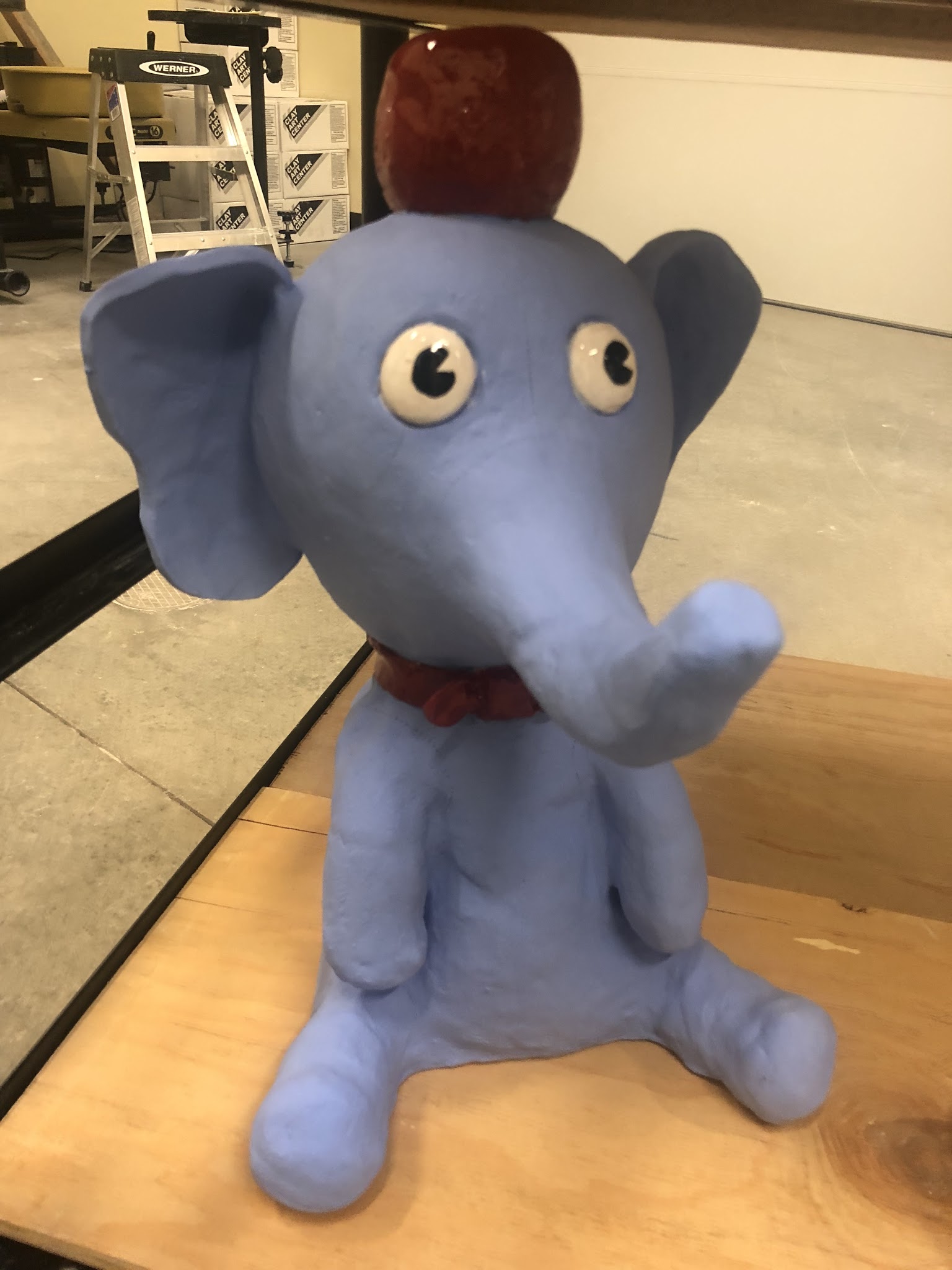
This stuffed elephant sculpture by Margarita Cruz (Winter 2018) was built almost entirely in one day. Circumstances beyond her control prevented her from attending class, but she watched all the videos, then came in and just worked really hard for hours one day to get it done.
In an online class, technique demonstrations are about as good as in an in-person class, especially since most of my main demos have been moving online over the past several years anyway. The written assignment directions are probably improved quite a bit from when the class meets in person and students have ready access to rubrics right away (rather than whenever I get around to sharing them). I've actually improved my specificity in communicating to students things like how thick the wall should be, and I've added demonstrations to show them how to do many of the "little" things that sometimes get demonstrated in class, like how to measure wall thickness, flip a wide scupture, and substitute tools.
a video from a playlist on carving solid, this one captures some of the "little" things that might otherwise be demonstrated in class
But I can't peek over the students' shoulders and casually let them know that they have more carving to do. I can give them this feedback when they meet with me or once they have submitted their assignments, but once they've submitted something for grading, this kind of feedback seems like criticism rather than support. Importantly, I can't catch them and stop them in the moment before the piece is going to collapse and help them brace it and understand what happened. This I do on-campus both during and between classes when students are working in the studio.
Segmented bowls, carved from one solid log (see video above), class example
Also, vitally, they've lost some significant amount of their in-class interactions with classmates. They still can interact with classmates in critiques and other discussions, but there isn't the kind of automatic time spent working together. For several years, as I've been working to flip my classes, I've discovered that the flipped modality, especially in the Hand-building and Intro to Clay classes has allowed students to take on some leadership and peer support roles in the classroom. For the past several years, I've had students work on different proejcts in the same space, meaning that one group of students is working on the 3D printer, while another group is using the extruder. This means that students learn the tools and techniques in different order from their classmates, then are able to support their classmates who are getting to those tools and techniques later.
Notan Cut Paper, Jordy Marquez, 2D Design, Fall 2020
Obviously the working on different tools part doesn't translate well when students don't have access to many of those tools, but I think there's some level of discussion between classmates that happens in a live class but is difficult to replicate online. So in my online studio classes I haven't really figured out how to look over students' shoulders and I haven't figured out how to get students to support their classmates. My classes are asynchronous, and thus don't have a designated meeting or work time where I can see them working. Some online classes meet synchronously, and maybe that's what I should be doing, but that's now how I've set up these classes.
Line Project, Marvin Mendoza-Rosas, 2D Design, Fall 2020
Design Class Online
Last quarter, my other new online studio class was Two-Dimensional Design. I hadn't taught the Design class in years and never had any elements of it online, so I designed that class from scratch, including projects, check-ins, and timing that were planned for online first, rather than modified from a face-to-face class. In the Design class, I had weekly projects, with 1 or 2 "planning assignments" that directly related to the projec, as well as a set of interactive content lessons and sketchbook assignments designed to help students learn each week's composition or formal element of art terminology.
Notan Project, Kyle Win, 2D Design, Fall 2020
In the clay class, on the other hand, I kept the project timing basically the same, with 2-3 week projects, demonstrations and interactive lessons. My changes were mostly to do with techniques and with creating new demos and information about projects to put online. Since students didn't have access to the same equipment as they do on campus, I couldn't reuse the projects, and since we couldn't learn basic technniques, clay processes, recycling, and kiln loading in the studio, I had to move all that online as well. I reduced the size of projects a bit, to try to account for traveling with clay for firings, and added to the section on taking quality photographs because photos (and video) are the only ways students can show me their work.
Notan Cut Paper, anonymous student example, 2D Design, Fall 2020
In both fall classes, I required students to check in with me roughly every other week. This was a quick ~10 minute check-in via Zoom (or phone or email if their schedules and/or internet connections couldn't accomodate Zoom) for me to check that students have started working, answer questions, and help make sure they were moving in the right direction. I knew I wanted to make up for the lack of face-to-face interactions, but a 10-15 minute check-in each week with each student would be ~9 hours of my week spent doing check ins. As I write this, it occurs to me that some sort of group check-in might work (and I could maybe give the students a chance to check in with their classmates, too).
Color Collage by Jordy Marquez, 2D Design, Fall 2020
I've been particularly concerned with scheduling in flexibility, not just because the class is asynchronous, but because so many students seem to have such complicated schedules. From what I've seen, during the pandemic it appears more of my students are working full- or part-time and taking at least a full load, while also helping the family or raising kids. It's really alarming, actually, and I both see where it comes from (they've got bills and responsibilities, and they think they can make it work), but know it is unsustainable. I worry that students are going to burn out, but I'm really saddened that students are not getting as much out of their college education and experience because they are exhausted from trying to do it all at once.
Color Collage by Kyle win, 2D Design, Fall 2020
This quarter, several students have informed me that they are taking 4 classes (a normal full time load is 3), while also working. And, of course, we know they are also dealing with the additional stress and uncertainty of living and working during a pandemic. I suspect that the thinking goes something like this: "since my classes are online and don't have a meeting time, I can add them in anytime." But the thing with a college level class is that you can move the work around, but you still need the time! Students who have taken on too much come to their classes exhausted and unable to function. They can't understand as well when they are tired, and I assume the same thing happens in their job and their families, too.
Color Collage, anonymous student example, 2D Design, Fall 2020
In the fall, I noticed that the Design students were more consistent in turning work in on time. I realized that their class had more built-in check-ins than the clay class. Besides the biweekly check-ins with me, they had a number of other opportunities to get feedback and show me that they were working. Their interactive lessons and sketchbook assignments functioned as both an early deadline to get started on the week's work and a check to show us both if they understood the content. My feedback via Zoom and email answered the questions they asked, and the submission feedback answered those they didn't. The Design students also had what amounted to a kind of weekly progress check via their planning assignments. They didn't just submit the project, they did the planning work beforehand and got feedback on that planning work before moving onto the project itself. Not all of the students made the connection that the planning assignments were planning for the project, but the vast majority did and I believe that helped them space their work over the course of a week.
Segmented triangular vessel, carved from solid, class example
I imagined that the clay students would follow along with the building demonstrations early in the week and get started on the project early enough that they could spend time on it every day or every other day for a couple of weeks. In reality, I think this often didn't happen.
Notan Project, Israel McDonald, 2D Design, Fall 2020
This quarter, in the clay class, I decided to build-in more of the required checks. Students still have two-week building projects, but I have added a mini-building project each week. Some of these preparation assignments, like the interactive pinch-building demo on day one, would have been done in class normally, but others were added as a way for me to check that they can do the technique and check that they've started the project. I'm not sure I've hit upon the most elegant solution, but it's an improvement over last quarter.
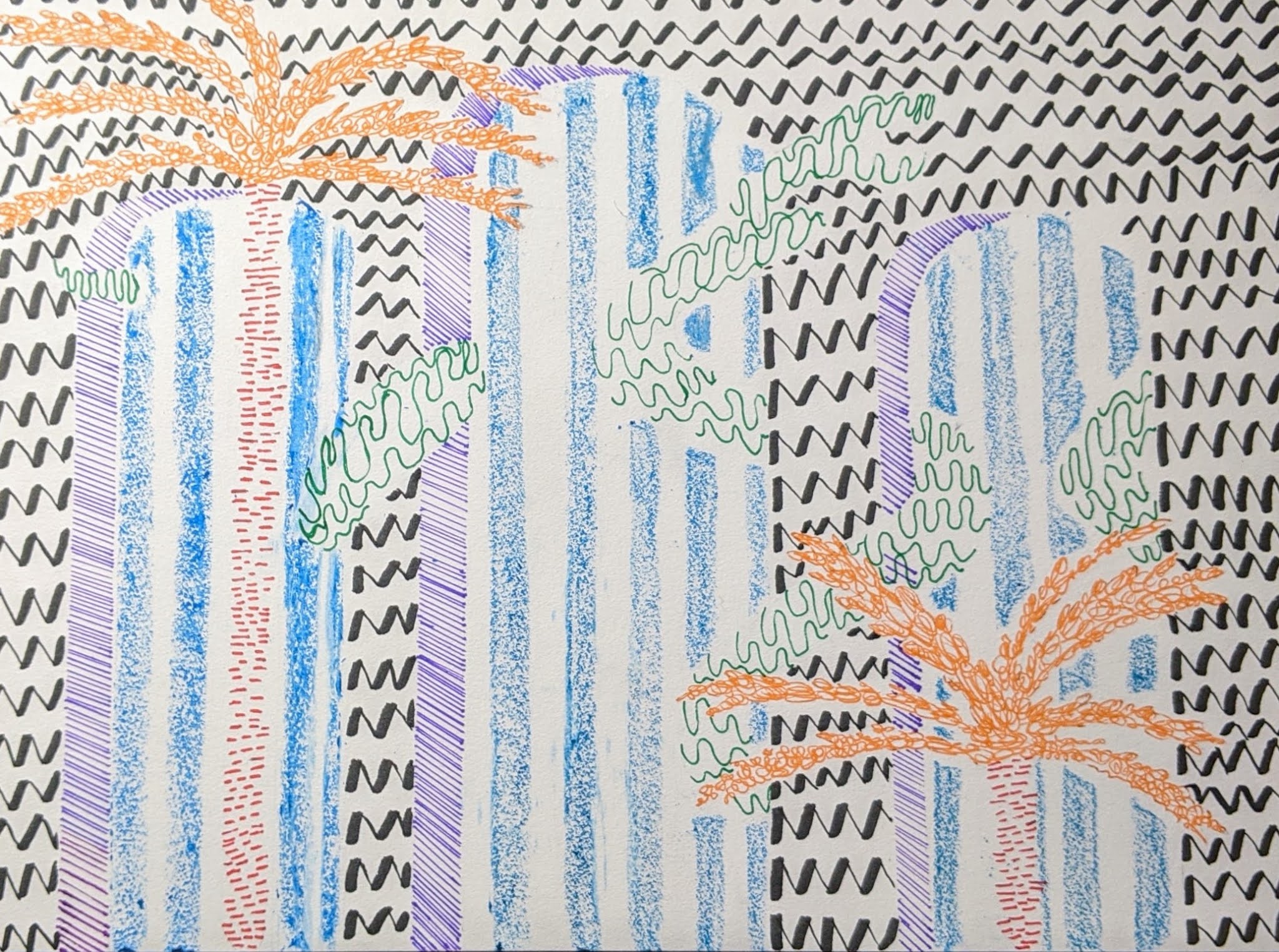
Line Project, anonymous student example, 2D Design, Fall 2020
Why I Blog
Writing about my classes, like writing about my work often helps me think through the various elements of an issue. When I started writing this morning, I thought I was writing a blog post about the carving project I added this quarter. I've never had students carve from a solid block of clay before. They've hollowed out solid sculpture using carving methods, and I've had at least one student try Ayumi Horie's dry throwing technique, but this quarter's was an entirely new technique designed specfically for students working at home.
one of a series of demonstrations (new this quarter) I made showing this solid carving technique
Maybe I'll talk about this technique in future, but as I wrote I realized that the bigger issue on my mind was (and is) what is missing from the current online studio that I think is important to capture. I'm not sure if you caught it, while reading, but my "aha" moment (or at least a glimpse at what could be an "aha") came around the 10th paragraph (right above Jordy Marquez's orange and blue collage), when I connected three separate bits that have been floating around in my head: 1) Important stuff happens in casual conversations in groups in the studio 2) I don't have time to meet each student individually each week and 3) I'd like to have a more casual way of peeking over students' shoulders to make sure they are on track.
Line Project, Kyle Win, 2D Design, Fall, 2020
I'll have to think a bit more about how this will work, but right now I'm thinking that instead of just checking in with me, students could have a required check-in with classmates in which they share pictures of their work space, what they're working on, and talk about what's going well or not. It could bring in the quality conversation of a critique, without the tension and expectations of a graded project. It could also help take the sole burden of feedback off of me, while helping empower the students to support each other. Stay tuned, I guess.
Artwork Note: All student examples are used with student permission, anonymous examples are from students who asked to remain anonymous but gave permission for their artwork to be shared here. Clay class examples are my work (since their project is due tomorow).