Showing posts with label flipped class. Show all posts

Wednesday, December 14, 2022

My Impressive Wheel Throwers, Fall 2022

Student work, raku fired, Fall 2022

Teaching Functional Pottery at YVC

Functional Pottery was one of the classes I was hired to teach in 2006. When I started that fall, fresh out of graduate school, I taught Functional Pottery, Art Appreciation, and Design 1

Ella Steinhilb mugs


Though I was primarily a ceramic sculptor in undergrad and graduate school, I had been teaching myself to throw better during the last year or so of graduate school when it became clear that so many of the teaching jobs expected the applicant to teach functional pottery.

Ella Steinhilb mug


Throwing for my Job

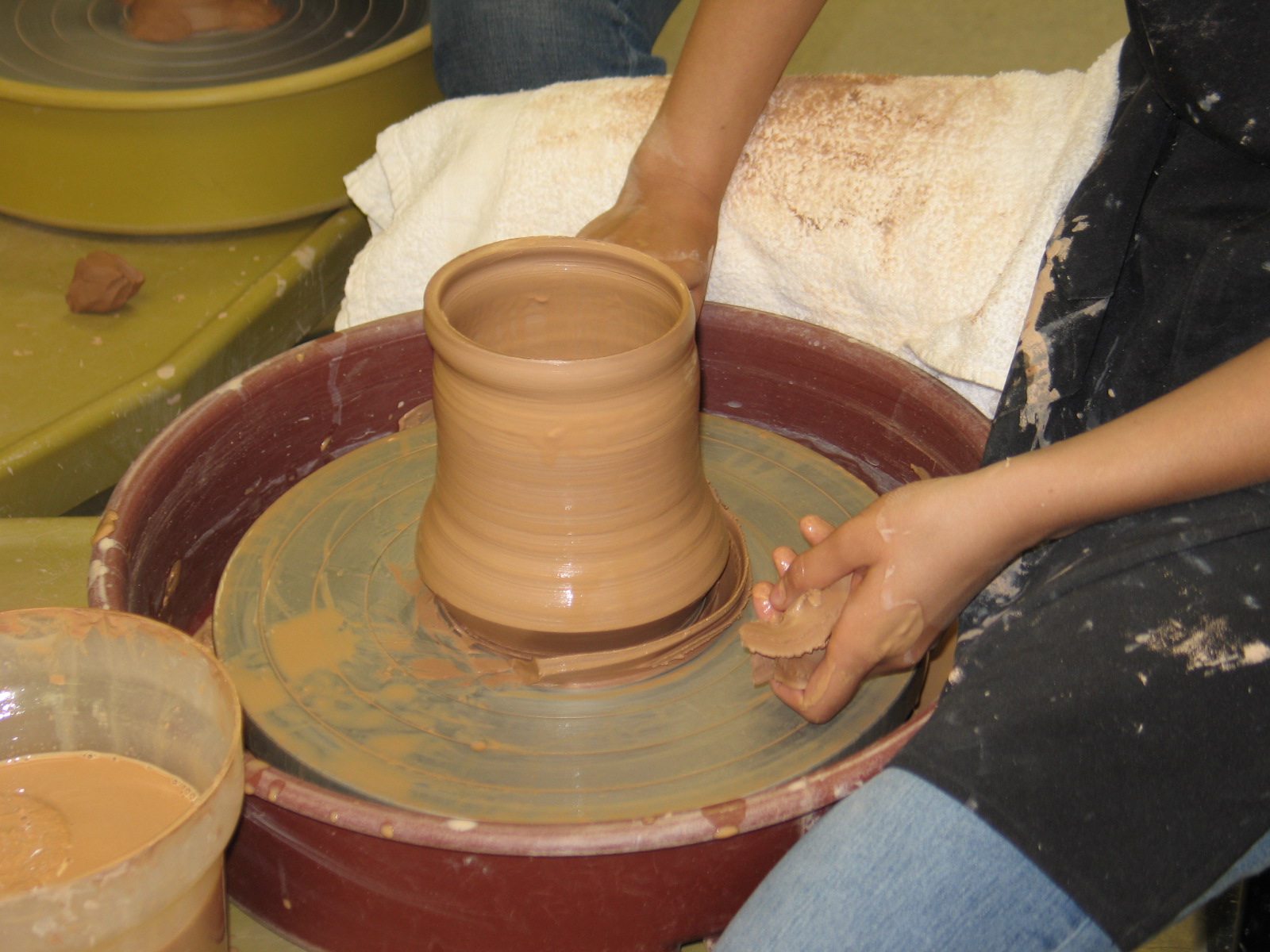
In fact, my application to teach at YVC required a throwing demonstration. I believe it specifically asked me to send in a video of a begining throwing lesson. So my brother borrowed a camera and came to my tiny sub basement studio in the education building to film my throwing demo. Neither of us know a ton about video editing, so it was a one-take kind of situation. While I was demoing, I made a mistake and ripped the rim or something. I thought "well, there goes that application." But I kept talking while my brother continued filming.

Bowl by Rachel Barfus


On video, I said something to the effect of "well, sometimes that happens and when it does, here's what you can do to fix it" and then demonstrated how to cut off the rim of the bowl I was throwing.  Nowadays I build in mistakes into my throwing demos so that I can show students some typical beginner throwing errors and how to fix them, but back then it wasn't a strategy.

Student work, teacups


The coda to that story is that years later, when I had been teaching at YVC for years, I ended up having lunch with Dr. Kaminski, the YVC president, and she said to me that she remembered my throwing video because it made her feel like she could throw. 

Teapot by Andrew Martinkus

My Classes at YVC

Over the years, besides the three I was hired to teach, I've added other classes, most of which I designed or redesigned before teaching.  These including intermediate clay and design classes, advanced pottery classes, clay hand-building, a team-taught Design/Photoshop class called Design One Byte at a Time, and an experimental class called Mural in a Quarter. After I'd been at YVC several years, I remember my colleague, Bob Fisher, asking if he could take back the Design class, which he had taught before I came to YVC. 

Three cups by Andrew Martinkus


Bob left YVC at the end of the Fall quarter in which I took my sabbatical. When I returned to campus, Bob had left, our adjunct Art Appreciation faculty had taken medical leave, and a miscommunication had prevented YVC from advertising for part time faculty to teach art classes. All of this conspired to mean that immediately after my sabbatical I taught three sections of Art Appreciation as well as my Functional Pottery class. I don't remember the clay class that quarter, but I remember finding it disorienting to teach three sections of the same lecture class in one quarter--I kept feeling like I was repeating myself (because I was).

Student work Fall 2022


I also remember bargaining with my dean that I'd teach duplicate classes (because of a scheduling error or faculty shortage) in one quarter, if the next quarter she let me teach Clay1: hand-building as a stand alone class the next quarter. Of course I did and she did, and I've taught hand-building once a year or more ever since.

Student work Fall 2022


By Fall 2015, I was teaching Intro to Clay (throwing and hand-building together in once class) as a stand alone class. Sometime before that, maybe Winter of 2012, I taught my first stand-alone hand-building class (I was talking about making musical instruments in that class in fall 2011--and, oof, reading my very old blog posts is strange, they feel and look very different from how I write now).

Student work Fall 2022


Through my 16+ years at YVC, my teaching load has shifted from 1/3 clay to 2/3 clay most quarters. At some point around 2014 I also stopped teaching Art Appreciation so that I could teach the Western Art History series. I taught Ancient & Medieval Art history online this fall and last fall, but during the pandemic I went back to teaching Design (online) and Hand-building (online) most quarters. 

Carmen Nelson, blue and white vases


While I was on medical leave last year, my colleague taught the Renaissance and Modern Art History classes. This quarter, because we again had not enough studio faculty, especially in Grandview, I am teaching online design and he is taking the Renaissance Art History class.

Carmen Nelson, red and purple

Functional Pottery is Consistent

Though my other classes have switched around quite a bit over the years, I think I have taught a functional pottery class every quarter that I've been on campus.  If I'm counting correctly, I've taught functional pottery 42 or 43 times at YVC.

Carmen Nelson, flames ashtray


I was telling students this quarter that when I look at their work during critique, I am comparing their work against a massive catalog of beginner work from more than 16 years of beginner classes. I brought this up this quarter, in particular, because the work was consistently of high calibur across all students. Even the students who struggled the most this quarter, compared favorably against students who struggled the most in previous quarters. 

Carmen Nelson purple and white teaset

Magical and Non-Magical Classes

There is some magical alchemy that happens some quarters that causes the dynamic in the studio to produce high quality work. I've observed it over the years and those quarters are so energizing as a teacher. I think the basic ingredients are a full or nearly full class, a couple or three students who were going to work hard anyway, and then somehow the mood and the atmosphere in the studio has shifted just right so that everyone works harder, tries more challenging projects, or simply shows up. It helps to have an intermediate or advanced student or two in the studio to help get the magic started.

Carmen Nelson, teapot and flames


Other quarters, those same students, mixed in with a different group of classmates, or in a class that's simply too small, the magic doesn't happen. Often when the magic isn't happening, the visible results are that students are missing class, they don't come into the studio outside of class time, they might miss a critique, and one or two students doing this infects the rest of the group in the opposite way, encouraging more and more people to take on easy projects, miss class, etc.

Carmen Nelson teapot (detail)


The basic magic/no magic I've observed quarter after quarter after quarter. Obviously I try to control for making a studio atmosphere magic, but I can't always control it. Low class enrollment seems to be an almost insurmountable hurdle. The only think I can do about it is advertise the classes and help with advising. 

Searra Rodriguez handleless vase


Last fall was an exellent example of a whole list of "don'ts" for building a magical studio atmosphere. We had low enrollment to start. I was forced to limit studio access because of the lack of student workers and because of the pandemic restrictions. I, personally, got fairly distracted partway through the quarter and had to cancel class or close the studio more often than I wanted to. Some students got sick and had to miss more than a little class. And when we were in-class, we were trying to social distance.

Searra Rodriguez Cindy's Shino vase


The wild thing, and something I want to be clear about, is that students in these classes aren't worse than students in the magical classes. I fundamentally believe that if you pulled any one student out of the non-magic class and put them in a magic quarter, their work would improve--regardless of whether they started as the best, the worst, or somewhere in the middle of the other class. And I think it works the other way too.

Searra Rodriguez horse hair raku vase


One fascinating thing for me this quarter, is that while the in-class and in-studio work was consistently high quality, the online work was really hit-or-miss. I've flipped my throwing classes for quite a while now. Students can watch video demos instead of in-class demos, though I also offer in-class demos as alternatives or in addition to the videos. More recently, I've shifted lectures in the Functional Pottery class from in-person events to online interactive lessons that students can do on their own time (including evenings and weekends when they can't access the studio).

Searra Rodriguez pitcher


This quarter, while some students regularly did all the interactive lessons and assignments, others regularly did not do them. Or didn't do them until weeks later. I was annoyed by this, but couldn't figure out why it was happening when it hadn't happened before. It wasn't until well into the quarter that I realized what had happened.

Searra Rodriguez pitcher


In previous quarters, if students didn't do the pre-test (which was due before class/at the start of class on the second or third day), I would sit them down in the studio and make them complete it before they could throw or participate in the rest of class. I did this especially for the online studio safety lesson (that replaced a long and repetitive talk about safety on day 1 and 2).  But with not teaching the class during the pandemic and then after another break for my cancer stuff, I had forgotten about this teaching tool.

Searra Rodriguez mug


Over the years, I've developed teaching patterns and strategies and lots of them are written down, but this year, in particular, I learned how many things that "I always did" weren't written down and thus got forgotten or missed this quarter. Obviously I am making plans to bring back the big ones next quarter.

Liliana Morales vase

Functional Pottery Projects

I've kept the functional pottery class projects almost exactly the same year after year. They start with bowls (I once tried experimenting with having them start with cylinders, but I didn't like it and switched back), then cylinders. They have to make 2 at least 8" tall. Then for their third project, they can choose handles, lids, spouts, or all three in the form of teapots, mugs, canisters, or pitchers (or some combination of those elements).

Liliana Morales gold set


Unlike in other classes where I switch projects around, decide I don't really like the parameteres, adjust the order, etc. In the Functional Pottery class, I think the projects just make sense this way. They get lots of centering and trimming practice to begin the class. They get pushed to increase their size in the middle, then for the last project, they have some choices and more room for creative solutions.

Liliana Morales gold twisted teaset

I have, as I mentioned above, switched much of the stuff that surrounds the projects. Demonstrations used to be entirely in-class, then I created some supplemental videos, then I replaced all of those and recorded a a massive quantity of videos, then I decided to offer students a choice to flip the class and watch all demos online and none in person.

Liliana Morales blue vases


Now I've settled into something I think I like, for now at least, which is the choice to flip the demos, with a few demos required in class and a few "extra credit" demos offered only online, but most students choosing, day by day, whether to flip or not. Students don't need to choose ahead of time; they can simply watch the videos one day and watch the in-class demos another. Or they can always watch both. 

Kevin Arellanes, lidded set


What to do when they haven't watched

Sometimes in clas, I notice that students haven't understood the demos (or possibly haven't watched them). My solution is usually to single out a few students and say "this in-person demo is for you". I'm always a little worried about doing this in a way that embarasses students, but frequently when I do this I am noticing a particular thing they are doing that is just a bit off. An example would be a student who keeps leaning too far forward while centering. Though I've touched on this in the standard flipped and in-class video demos, it's a little hard to notice this as your own problem until it is pointed out. For a short in-person demo after I notice this problem, I would target certain students and would exaggerate the problem on my own wheel so they can see it at theirs.

Kevin Arellanes, lidded set


The one probel I really feel I haven't solved, however, is what to do with a student who says they've watched the videos, but it doesn't look like they have. Especially when this student has missed class or is asking for early-quarter things late in the quarter (often they also ask this late in the day). Obviously when there's time, I will redo intro demos quite a few times, but there gets to be a point where we've got so much else going on in the classroom (kilns, glazing, other demos) that it is difficult for me to stop or interrupt that to demo things they've had multiple opportunities to watch already.

mugs by Jazlyn Alexander. Jaz was in intermediate wheel, which met at the same time as functional pottery but had different and more challenging assignments


In this case, it is difficult to simply send the student to the video demo (which I do early in the quarter if they miss class and want a demo I don't have time to do in class or between classes). By late in the quarter, if the student hasn't watched the video demos (or if the video demos haven't helped), sending them to watch them is unlikely to be effective. 

Jazlyn Alexander, white bowl with drips

Class Time

Functional Pottery (and Intermediate Wheel) classes meet twice a week for about 3 hours. This time includes mostly live-demonstrations on the wheel and student work time. Of course, it also includes instruction and practice for loading and unloading kilns, glazing, surface decoration, studio processes, ergonomics of functional forms, critiques, and more.

Jazlyn Alexander, tall blue vase


I think the most valuable regular use of my time during class, though it often isn't something strictly scheduled, is watching students throw and checking in with them about that throwing. They can watch me throw in-person or via video, but if they don't get feedback on what they are doing, it is hard to take in every single nuance of the process and apply it to themselves.

Jazlyn Alexander, tall vase with handles


When I watch them throw, I can point out adjustments to wheel speed, position of their hands, speed and pressure of their movements, amount of throwing slip, tool use and positioning, and issues specifically related to clay body, centering, drilling, pulling, and finishing. In a shared classroom, I might intereact with students entirely one-on-one for some adjustments, but I might also notice that a group of students are all having a similar issue.

Jazlyn Alexander, tall splatter vase


Also in a shared studio, students can overhear my instructions to a classmate and that may not impact them immediately, but it might be something that they adjust on their own later. One thing I worry about, just a tiny bit, is how well this pratice will age with me. I usually squat down in front of the students' wheels to watch them throw. And I regularly walk through the wheels (we have two rows of four wheels facing each other on two sides of the classroom, so I can see 8 students throwing as I walk up one aisle).

Jazlyn Alexander, mugs


However, this quarter I noticed that I was getting more tired from squatting down between wheels than I remember. This year of treatment has been a doozie and I know that the side effects of both radiation and the current hormone therapy include fatigue and joint pain. I'm hoping that, as I get back to more regular exercise, I will gain more stamina, but this was the first quarter I really wondered about how my studio teaching practices will need to adjust as I age (the good news being that last fall, I was just hoping aging was something I'd get a chance to do).


Jazlyn Alexander, lidded jar

Shared Studio

The other great thing about a shared studio, especially one with intermediate, advanced, or independent study students, is that they can teach each other. If I tell one student about a particular technique on Tuesday, they might share it with a classmate on Wednesday (between classes, when I'm not around). Intermediate students have already learned the basics, so they can help beginners, especially early in the quarter, but also late in the quarter when the beginners want to try more challening forms and, in a magic studio, might start looking across the wheel aisle to see what that other student is up to.


Jazlyn Alexander, mushroom tea set

The fact that I have lots of video demos online helps with this, because students can look ahead. I also encourage them to watch other throwers in person (in the studio) or online. I always try to tell students why I suggest a particular technique or tool, because I want them to understand why another potter might do it differently than I do. When both approaches accomplish the same goal, the student can choose my way or the other.

Jazlyn Alexander, mugs

Of course, I also try to give students the tools to know when they shouldn't try another potter's approach. There are some potters online, especially on Instagram, who throw very fast. The speed with which they move the clay can be a factor of their skill and experience, but it can also be because the clay body they are using can handle that speed (while our frequently recycled class clay cannot). And, of course, there's always the possibility that a video is sped up artificially.


Jazlyn Alexander, plates

It can be frustrating to watch an expert throw in a way that seems impossible for a beginner. Sometimes the answer is more practice, but sometimes this answer is that even that potter didnt' really throw that fast.


Jazlyn Alexander, raku bowl


Right now all my studio classes (Functional Pottery, online Design, and Handbuilding 1 & 2 together) are full. I hope that, and the large group of intermediate students in Handbuilding 2, means that my classes next quarter will be as magical as this past quarter. I also hope and plan to bring back some of the forgotten practices around what to do when students don't do the required online prep. 


Jazlyn Alexander, raku dishes


Wednesday, August 25, 2021

Announcing: Two On-Campus Clay Classes this Fall!

Student work from Clay 1: Hand-building and Functional Pottery at the Spring 2019 Student Exhibition. The foreground sculpture is "Judas" by Jennifer Martinez, the bowl on top is by Ruby Mayo.

This week I got approval to offer two clay classes on campus in the Fall. I will be offering Functional Pottery and Clay 1: Hand-Building, both as hybrid courses, meaning they will be on campus 2 days a week and online for 2-3 hours a week. Students will also have some access to the Yakima Valley College clay studio (in Yakima) to practice throwing, meet with me, or work on projects.

student throwing on the potter's wheel (in the old studio in Palmer Hall)

Though YVC is mostly online this fall, a few classes are being offered on campus, including lab sciences, art making and performing art classes, as well as Workforce Education classes that have accreditation requirements for in-person classes. I wasn't able to offer classes on campus last year, so I am very happy to be going back, even in a somewhat limited capacity, this Fall!


don't wear your mask like this


We will, of course, be wearing masks during class. This isn't such a big change, as we wore masks in the clay studio pre-pandemic for glazing and clay mixing. But we didn't generally wear them on the wheel. All faculty and staff must also be fully vaccinated by October 18 (I'm already done) and students are encouraged to get vaccinated as well.

me, in March 2020, trying to figure out how I would tell a student something about the wheel from 6 feet away

A year ago, the 6 foot distancing requirement would have made it difficult to have class in person, even though our studio is pretty big, but the new requirement is 3 feet. In most cases we already had 3' or nearly 3' between wheels in the studio.

the YVC studio wheels as they are currently set up

I'll need to rearrange some of the wedging tables and we'll need to glaze and load kilns in shifts, but much of that we already did to some extent. It's a lot easier to imagine teaching someone to throw from 3 feet away than from 6. On the other hand, spending the last year + teaching via video puts any kind of physical distance in perspective a bit.

Palmer Martin Hall, where the YVC clay studio and my office are located

Read on if you are interested in what we're going to to be doing in these classes this fall. If you are a student, you can find information, times, and entry codes at the Yakima Valley College class search tool here. If you aren't yet a student but would like to take a clay class this fall, check out YVC admissions page here. You can also contact me for help or questions.


Functional Pottery

Functional Pottery was added to the course listing just yesterday. This class will be set up nearly the same way it was when I taught it pre-pandemic, in Winter 2020. The class will meet on campus twice a week (Tuesday and Thursday afternoons) and will also have an online component as well.

student throwing on the potter's wheel (in the old studio in Palmer Hall)

YVC is trying to ease back into on-campus offerings and still wants to limit the amount of time that students and employees are on campus together. For this reason, the class meeting time is a little shorter than it had been. Instead of offering students the option to "flip" their class by watching demos online, they will be required to watch demos online.

screenshots of some of the many interactive online tools I created around clay, firing, and glazing this past year

I've spent a lot of time and energy over the past year putting together online activities and interactive lessons for hand-building, including interactive lessons to introduce glazing and loading and firing kilns. I plan to use some of those lessons for throwing students this fall as well.

students in functional pottery made bowls, mugs, teapots, pitchers, vases and more

Students in Functional Pottery class will throw bowls and cups, probably mugs and maybe teapots, lidded containers, and/or pitchers (students have some options in their third throwing project). Students will also glaze and fire their work and will get some hands-on experience loading kilns, in addition to what they learn about kilns and firing in the online part of the class.

raku firing during class, playing with fire!

I have lots of examples of student work from previous quarters in this class. You can check out many of these examples in previous posts on my blog (links in blue). 


Clay 1: Hand-Building 

The Clay 1: Hand-building class is also moving from online to hybrid. It will meet on Monday and Wednesday monrings and will also have an online component. This class is one I did offer all year, but I believe I will be able to offer students a higher quality experience my meeting them on campus for some of the time.

This very full kiln represents some complicated glazing techniques, not to mention large and complex building methods that just weren't achievable in an online class. Sarcophagus by Isabella Johnson.


Offering hand-building online was pretty different from offering it on campus. The class "worked" and I had a number of students both successfully complete the class and make quality work, but I also had an unusually high number of students run into troubles that caused them to be unable to complete the class.  I think that most, if not all of these students would have been successful if we met on campus at least once a week. 

The online class forced us to work small. Small work can be quite good, but it was a forced limit, rather than a choice.

There were lots of challenges that resulted in more frustration from students. One challenge was finding a decent space (and enough time) to work with the clay at home. Lots of students made the best of their situation and made good work, but I could sense that students were more frustrated, more often than in a "typical" quarter. Some students experienced this frustration more than others and I was frustrated to not be able to help in the way I knew would be most useful (in person).

My home studio is a dedicated space with work tables, storage shelves, floors I can mop, drawers for tools, and a potters wheel and wedging table. Most people don't have this space at home.

As I move this Clay 1: Hand-building class to hybrid (some online and some on campus) it will be going back to nearly what I was teaching before the pandemic. Like Functional Pottery, we'll be spending a bit less time on campus and a bit more time online than in the time before the pandemic. For safety, travel, and flexibility reasons, this is good, and I do have lots more stuff online for students now compared to a year ago. 

These carved boxes by Kristin Benjamin in the online class were made for a project that was brand new for the online class.

I suspect we may find, when everything is "back to normal" that this class would benefit from a bit more time on campus, but I may be surprised. It may be that after a year and a half online, student and faculty both are better at balancing their time between online and on-campus aspects of a class. I know I have more resources to share with students (not to mention better technology at home with which to connect). I suspect the level of comfort and familiarity with online learning tools has jumped significantly for many students over the last year and a half. 

Jayleigh Butler's fingers climbing out of a planter was created for an installation project created for the online class to take advantage of the fact that not all students could bring their work to campus for firing.


The particular projects and parameters changed a bit when I moved hand-building online, and I plan to change those expectations and projects again as we move into the studio. In the hybrid class this fall, we will build sculptural forms using coil, pinch, solid-building and and slab methods. We may also use the extruder, molds, and/or the 3D printer as we did when we were last on campus, or we might keep some of our stop motion animation and carving techniques from the online class

The kiln load from the above picture before firing. This is what the glazes and ceramics looks like before the glazes have reached their maturation temperature.

Unlike the online class, everyone will be able to glaze and fire their projects and load kilns. We will also learn about clay and glaze materials, processes, and firings. I plan for us to work at a larger scale than students were able to do in the online version of the class. I am also very interested in developing a project that, conceptually, references some of the upheaval of the past year, though I want to be thoughtful about how I do this in a classroom in which students may have had a really rough year.


I have lots of examples of student work from previous quarters in this class, too. You can check out many of these examples in previous posts on my blog (links in blue). 


The Advantages of Hybrid

I've worked really quite hard over the past few years to create a hand-building class experience that is designed to support students making bigger, better, more thoughtful, and more complicated work. One of the big changes I made a number of years ago was to flip this class. I moved all of my demonstrations online so that students could watch the demonstrations, at their own pace and on their own time, before coming to class. That way, class time was nearly all devoted to the students making work. 

This large turtle blew up in the kiln because it was too thick. This was made before I flipped my classes and I think the flip would likely have prevented this explosion.

Making work in the clay studio, as opposed to at home means that students can take advantage of four main features. One is obviously the space. The work tables and storage areas at YVC are spacious and sturdy and students can (with few exceptions) trust that their work will not be interfered with between classes. Compare this to working at home where children, roomates, family members, and pets might all poke at, bump into, or otherwise damage or destroy their works in progress.

students who wanted to fire their work during the online quarter had to very carefully wrap their fragile unfired greenware and bring it to campus in a box for firing, both a logistical and physical challenge

The second advantage is the tools and equipment. At YVC, students building scupture can use the slab roller, rolling pins, canvas, extruders, texture mats, textured fabrics, stamps, sprigs, carving tools, a 3D clay printer, a damp room, internal and external armatures, large paddles, texture paddles, drape molds, press molds, banding wheels, and more. And that's not even mentioning the real value, sometimes, of having a classmate hold a thing for a minute, while a student makes an adjustment.


Malea Esqueda used lots of tools and supports not available at home, including an internal armature, extermal supports, a helping hand from classmates, and special carving tools from the studio. See her finished build here.

The third major, significant, difficult to quantify advantage of an on-campus (or partly on campus) class is one I didn't even fully value or recognize before I started teaching this class online. It's me and the other students in classroom. Of course I knew I was valuable (they pay me, don't they?), but I didn't really comprehend how much I do that isn't written down or listed in a lesson plan. Sure, I do the demonstrations and those were relatively easy to move online. And I create assignment parameters and provide the students with the materials and struture for the project. But the really amazing thing to learn was how valuable it is for me to just be in the room while students are working. 

 Isabella Johnson's "Strider" got some leg extensions during class, just before this photo was taken. See what incredible progress was made after this photo here. Because she was working on it during class, I was there to help her decide on and execute the leg extensions.


While students are working in the studio (and this applies to handbuilding and wheel throwing, both), I am constantly monitoring what students are working on. Because I have much more experience with clay, I can anticipate problems before they happen. If a wall is getting to heavy or too wet, I can stop the student and help them adjust their build, timing, or plans to prevent collapse. I can look over students shoulders to check if their pieces are too thick or too thin. By catching errors early, the student can fix them (and improve their technique) before the piece starts to crack or collapse and before damage happens in the kiln.

Ashley Lawson was able to create a large, complex, and well-crafted box with a lid and drawer in her online class this Spring. She did all this without the advantages discussed here. 

Obviously I don't alway prevent every problem, but me being there is both a prevention and a boost to students' confidence. I learned this before and after I flipped my hand-building class. Before the flip, students would watch me build and cut apart a large sculpture on an armature during class. After class their homework would be to do the same. It was a big, intimidating assignment to do on their own. 


After the flip, students watched videos of me building and cutting apart a large scupture on an armature. (The added advantage being that the videos covered a longer time span and I could show them more of the steps all at once.). Their own building and cutting happened mostly in the classroom. On cutting day, I would simply walk around the classroom from student to student asking where they planned to cut, then, in most cases, telling them it was correct and to proceed. Having me there boosted the confidence of the students who were just a little worried. Of course I was also able to redirect those students who either weren't quite ready or didn't understand some part of the process.

Cutting into the sculpture is always the most intimidating part because students have just spent a week on this sculpture and don't want it to break. Sean Wilkinson finished this sculpture just before classes were cancelled in March 2020. See his finished build here.

Notice, too, that I said that the third major advantage is in having me AND the other students in the room together. Those other students aren't insignificant. Studnets often sit 2 or 4 to a table (we'll have to check spacing for Fall) and while I can't be looking at or helping 16 students at once, the suggestions and support I do give end up overheard and reproduced by classmates.  If I come over to student A to help them with the wall thickness, Student B and C at the same table might also see and hear that information and understand what needs to change in their own work. But then Student C might walk over to the next table and explain to Student D what I just said. And the next day, when Student D sits next to Student E who missed the last class, Student D passes the information on to Student E. 

Margarita Cruz missed some class because of a family emergency. She was able to come into the studio between classes and catch up on the project very quickly. Flipped class videos helped, as did her determiniation, but she was also working in a studio next to other students who she could talk to and ask questions about what she missed.

This sharing could theoretically happen in an online class, but I haven't figured out how to make it work yet. So the student sharing coupled with the space and equipment make it worth quite a lot, in my opinion, to be able to have this class meet sometimes on campus. The fourth advantage of being in the same space has to do with the sense of touch and how we observe and process information in real space. In the online class, students watched videos, did interactive lessons, answered questions, wrote about and shared pictures of their progress, and met with me on Zoom. All of this was great, but the third dimension and the feel of the material continued to be challenging to communicate in all these formats.

gauging wall thickness is just a seriously tough skill to develop without help

In a video or Zoom, it is just simply difficult to communicate those things that are usually communicated through the sense of touch. How thick is the wall of the piece (especially at the bottom)? How wet is the clay right now (and how wet should it be for this process)? How soft or flexible is the material? How much pressure should I exert with my fingers or this tool when the clay is this wet or flexible, vs if I wait an hour or two?

Other Challenges for Online Studio Classes in Clay

I have been teaching my hand-building class online for the past year, but I haven't been able to offer my functional pottery class since Winter 2020, before the pandemic began. The functional pottery class is all about throwing clay forms on the pottery wheel, but most students don't have space for a wheel at home, let along the ability to purchase one for class. 

My wheel at home, with clay wedged up and ready to throw. It's ok if I get clay all over the floor (and walls) in my home studio.


Even if YVC could have checked out wheels to folks, throwing on the wheel is a tough thing to learn on one's own. Having a teacher in person to correct and support you is really important. Of course the additional problems have to do with transporting a heavy wheel, keeping it in good shape, recycling the clay, finding a space to put the wheel (where you can make a mess), and keeping the workspace from becoming covered in clay or clogging everyone's drains with slip, slurry, and bits of clay in the sink or washing machine. 

Recyling used clay to get it to the right consistency can be a pain. It needs to be wet or dried (depending on the consistency) and then wedged. Here my daughter is foot-wedging a very large batch a few years ago.

I did teach Clay 1: Hand-building online all three quarters of last year. We put together studio kits and sent students home with clay, tools, and sometimes glaze, but working from home is tough, particularly when working with three dimensions and in a material that can be too wet or too dry, too thick or too thin. All this doesn't even address the complications of family obligations, noisy, crowded, or cramped home spaces, pets, kids, illness, and all the other things that can get in the way.

the studio kits we sent home with handbuilders.

I'm very much looking forward to teaching these classes online. I'm excited because I love to teach these classes and I miss being in the same space with students. I'm also looking forward to learning from this experience. After being online for a year, what will have changed? What will feel different? Will I teach the same way? Will students interact the same way?

This is where I've felt that I've been all year, set up behind a camera, and alone in a studio

I also anticipate that doing this with 3' social distancing and masks will be a little strange. On the other hand, our conceptions of strange have changed quite a bit in the past year and a half. 

Before kids could get vaccinated, I gave my daughter and her friends a throwing lesson, but we all wore our masks inside my home studio, so I've got a bit of experience.