Showing posts with label Martianware. Show all posts

Saturday, May 8, 2021

Mars (Martianware) clay, finally fired


Mars clay bulbs with small impressions (left) and flower stamp impressions (right)

I finally got around to firing some of the pieces I made last month with the new Martianware clay. In fact, I fired them a while ago and only just got around to taking pictures this weekend after my most recent glaze firing was completed.

Salty Mars covids and bulbs before firing

Since I wasn't sure about the clay, I didn't make a lot of items with it. Then, before firing I got concerned about the salts damagining my kiln walls or elements. The soluble salts show up on the oustside of the forms as the clay dries, and they also act like glaze mixed into the clay, creating the unusually texture surface. Firing a salt kiln can be hard on the walls and the elements. Though this was clearly a lot less salt than a salt kiln, I decided to play it safe and make some saggars in which to fire the work.

Saggars after firing

I threw and slab-built four saggars which I can reuse in future. Being extra cautious, I also fired the pieces on stilts which was probably unecessary, as it turned out. Based on how the saggars look inside after firing, I'm guessing these were unecessary, too. The floors of the saggars have a bit of spitting, little freckles of color, but the tops look just like the outsides, no damage.
 
Interior of a thrown saggar with salt speckling from the Mars clay

I fired the pieces in a bisque firing with a bunch of other greenware. This Martianware clay isn't supposed to get too hot. This bisque was cone 06 and fairly full. The Martianware ceramic surfaces have varied colors ranging from brown to red and a rough, crumbly texture. I can't tell how much their location during firing or drying or their building techniques impacted the colors, so I'll have to pay closer attention next time.

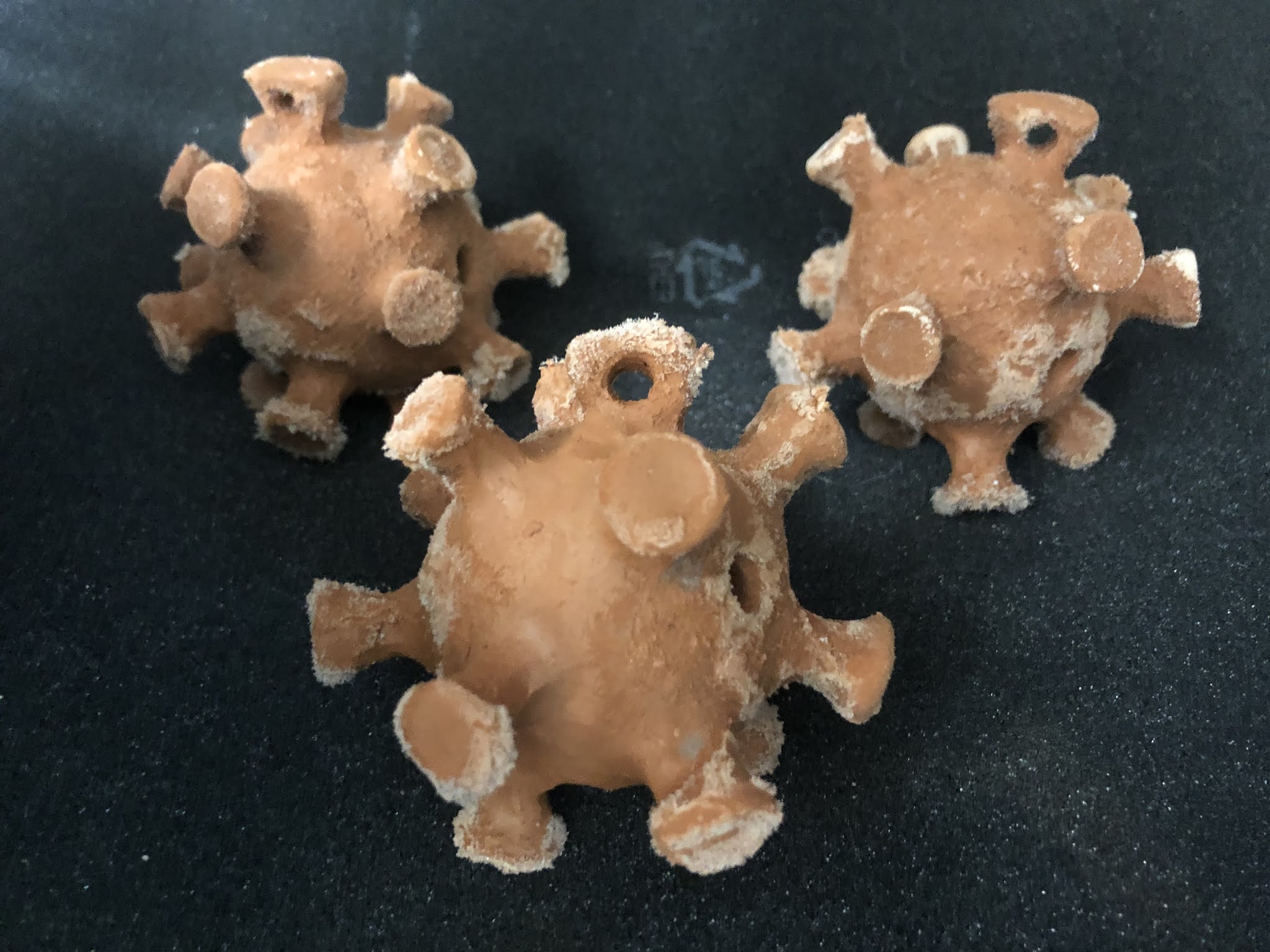
Mars clay Covid Balls

The surfaces feel crumbly, as is evident in some of the pictures where there are little dustings of crumbs that I didn't brush away. The bits that do flake off don't stain my photo paper and removing them from the surface doesn't seem to impact the colors of the original form. I haven't tried scrubbing these pieces yet, but they feel like raku work that needs to have the ash washed off.

Mars clay bulb (other side)
 
For a few of the pieces, I mixed the Martianware clay with my regular pugged reclaim and the result was underwhelming. Theese pieces just look like a bit of terracott has gotten into or onto the regular clay which looks white after bisque.

Mars and reclaimed clay Covid balls after bisque

In one case, as a test, I glazed the rest of the form (the part made of reclaimed clay) and left the inset Martainware clay circles unglazed. I then fired the piece to cone 6. As expected, the clay fluxed and bubbled a bit. I knew the clay wasn't designed for this temperature, but I was just curious what would happen. 

The black dots are actually the Mars clay fired to cone 6. The lines and yellow surface are glazed

I made COVID balls and Ericano bulbs out of the the Martinaware clay. On the COVID balls, I didn't do much to the surface, relying on the clay itself to create texture. For the bulbs I tried a few different things: sprigs, impressed stamps and a texture roller/stamp. The impressions look pretty similar after firing, as the clay sort of takes over and obscures the texture. The sprig additions are easier to see on one side than the other, based on the clay color and how it shows up differently in the higher and lower areas.

The front and back sides of the sprigged bulb made with Mars clay


The clay is fun, but working with something like this requires a really different planning process, especially for someone who is used to focusing on texture and color. I could see this clay working well for the darker, moodier work I did for my politics bulbs series, but I'd have to think about what can and cannot show up as far as texture. This clay could lend a gritty feel, but it could also obscured what I want to show. And, honestly, I've felt a bit exhausted in thinking about this work lately. 


Mars Covid ball


This past week I was a bit disappointed in my kiln results, which tends to be opposite of a motivator. But while I was photographing the work I realized that I had quite a bit of work. Some of it disappointing, but at least I've been making. Some loads are like that.


Sunday, April 11, 2021

Mars Clay

Martianware Covid balls the day after they were made

If you're a fan of space exploration, the most recent Mars rover, or clay, you might have heard that Seattle Pottery has made and is selling "Martianware" clay, a clay based on the chemical composition of soil on Mars. The idea is that if Mars had clay, this is what it would be like. Or maybe the idea is that people doing pottery think this would be amusing.

A freshly made Covid ball next to ones made yesterday.

As a potter, I found this amusing. If only to delight the 12-year old version of me, I bought some of this clay to play with. The wet color and even the texture does remind me of the surface of Mars that I made in elementary school for a science fair, though that was made of plaster and paint, I believe (and later was turned into a toy golf course after it sat in the basement for a while).

A freshly press molded bulb after being smoothed with a rib.

The clay is a low-fire, self-glazing clay, a bit like Egyptian faience. The materials in the clay include soluble salts inside the clay body. These salts react during the firing to form a glaze without needing to add glaze to the surface of the clay. This is similar to salt firing, where salt is added to the kiln during the firing. The salt adheres to and reacts with the surface of the clay, creating a slightly bumpy glazed surface.  

A bit of salt inside the raw clay

The clay feels very strange to work with. I only bought a small amount and this weekend I made some of my Covid balls shapes with it, as well as a couple of press-molded bulb forms. The clay is stiff and tends to want to crack, though it can be smoothed. It's work-able, but certainly not the most pleasant clay I've used. As I was cutting into my small block of clay, I encoutered several fairly large chunks of salt inside the clay block. I assume these pieces of crystalized salt had developed between when the clay was mixed and when I worked this it. I was easily able to crush the pieces, but they were large enough that I jsut removed them from the clay I was building with.

A press molded bulb resisting removal from the mold

It was fairly easy to build the hollow forms, but the clay did not want to be press-molded. Usually I can press clay into my plaster mold, leave it for 20 minutes and it just pops out. Though this clay already felt drier than usual when I put it in the mold, I couldn't get it out of the mold until the next day. After I tried it, I started wondering whether the salt of this clay was actually bad for the plaster of the mold. 
 

Thrown saggars for firing

I'm also slightly concerned about the elements in my kiln. Salt firing is only done in hard brick kilns fired by gas or wood because the firing process destroys electric elements and the soft bricks of most electric kilns. In fact, firing a non-salt firing in a kiln normally used for salt firing may yeild strange results, as the bricks themselves contain residual salt. For this reason, I also threw some containers to use as saggars, ceramic boxes to contain the clay. Firing the pieces in saggars should protect the kiln from the worst of the salt, but I think I'll double check Seattle Pottery's recommendations before firing, regardless.

Martianware Covid balls drying

The immediate change in the clay is interesting. I made some of the pieces last night and already this morning they've developed a salty fur over their surfaces. The salt is growing on the surface of the clay. It looks a bit like mold, but feels brittle and crumbly. 

my studio assistant was recently asked not to walk on my wet teacups

As I've gotten into the sudio fairly regularly over the last few weeks, its looking like I'll have a chance to fire fairly soon. Yesterday I mopped and cleaned all the tables, cabinets, bats, and my mixer. It's amazing how good it feels to work in a freshly cleaned studio.